You walk outside, look up under the roof eaves, and see rows of perforated metal panels. You assume your attic is venting cleanly and breathing properly.
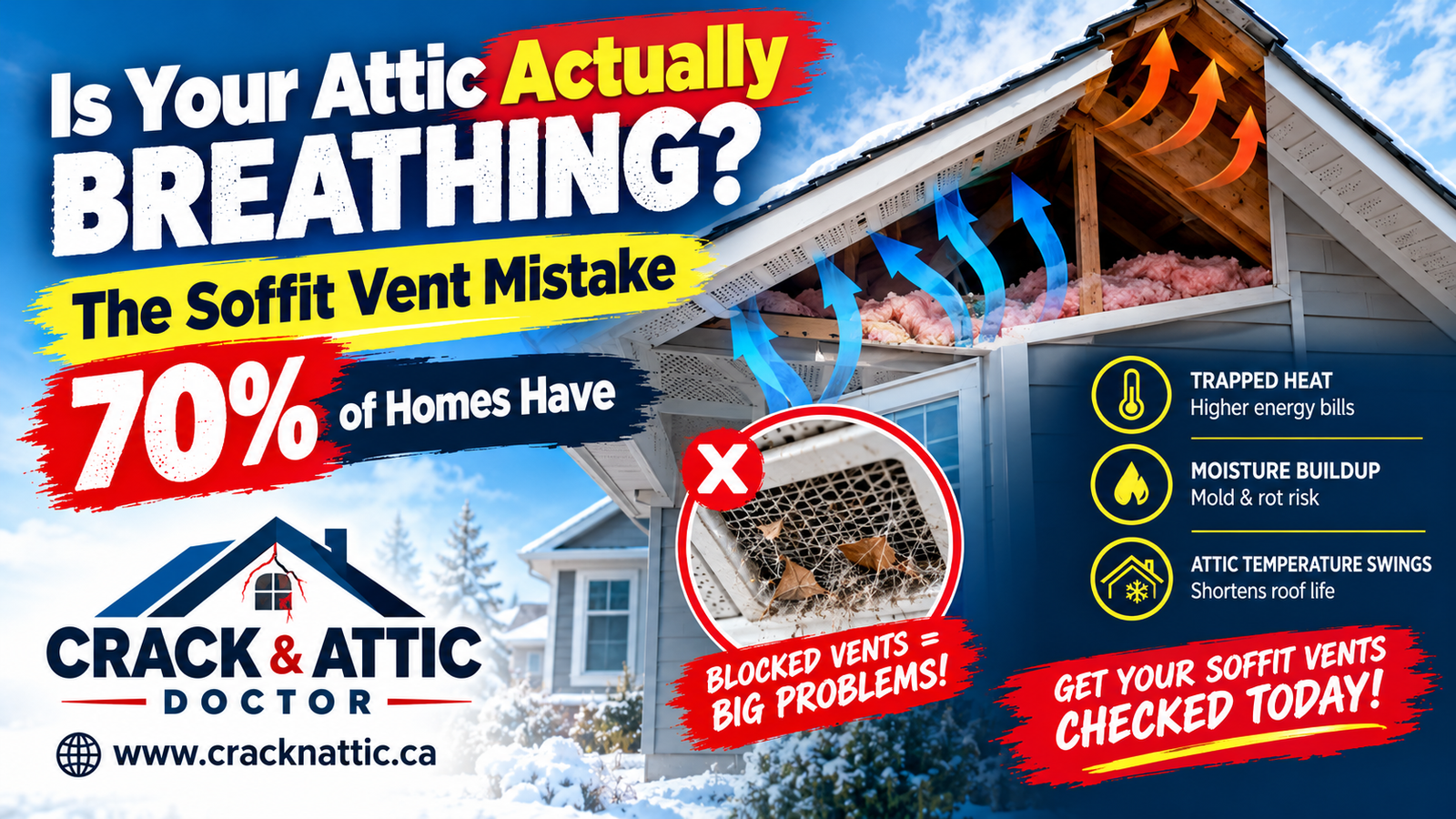
In Southern Alberta, roughly 70% of homes with perforated soffits are actually suffocating.
A vented roof requires continuous, passive airflow: cool outdoor air enters low through the soffits, sweeps across the underside of the roof deck, and exhausts warm air out through roof vents.
However, in seven out of ten homes, that intake pathway is completely choked off.
When your attic cannot breathe, trapped moisture leads to catastrophic winter frost, ceiling leaks, ruined insulation, and rapid mold growth.
Here is the common soffit vent mistake lurking in most Calgary attics, how to spot it, and how the Crack & Attic Doctor Solution restores proper airflow before winter hits.
1. The 70% Mistake: The “Choked Soffit” Trap
Why do so many seemingly vented attics fail? The issue comes down to two major construction and renovation blunders:
A. The “Fake Vent” (Uncut Plywood Sheathing)
During initial home construction or siding retrofits, builders frequently nail perforated aluminum soffit panels directly over solid plywood or wooden eaves without cutting intake holes first. From the street, the soffits look perforated and modern. Behind the metal panels, solid wood seals off all airflow.
B. Blown-In Insulation Overspray (No Baffles)
When older homes are upgraded with extra blown-in fiberglass or cellulose insulation—or when insulation settles over time—the loose material spills directly into the roof eaves.
-
Without rigid rafter baffles (insulation stops) installed between the trusses, the insulation packs tightly against the underside of the roof deck.
-
This completely blocks the soffit openings.
-
Cool intake air cannot enter the attic space, shutting down the entire ventilation cycle.
2. What Happens When an Attic Cannot Breathe?
An unventilated roof space is a disaster for Southern Alberta homes, particularly during our freeze-thaw cycles:
-
Attic Rain & Condensation Meltdown: Warm, humid air from daily cooking, showers, and laundry naturally rises into the attic. Without clean soffit airflow to flush moisture out through roof caps, humidity freezes against the cold roof sheathing. When a Chinook thaw hits, that frost melts instantly—raining gallons of water into your ceiling insulation and drywall.
-
Rapid Toxic Mold Colonization: Saturated roof decking and damp insulation create the perfect feeding ground for mold. In poorly vented spaces, mold colonies can spread across roof framing within 24 to 48 hours.
-
Destructive Ice Damming: Without cool intake air keeping the roof deck cold, warm trapped air melts the snow sitting on top of the shingles. Meltwater trickles down to the cold roof eaves, refreezes into thick ridges of ice (ice dams), and backs up under asphalt shingles.
-
Collapsed R-Value: Saturated blown-in insulation mats down permanently, losing its air pockets and thermal resistance. Your furnace runs constantly to compensate, sending heating bills through the roof.
3. How to Check If Your Attic Is Actually Breathing
You can perform a quick diagnostic check to see if your soffits are functioning:
-
The Flashlight Eave Test: Turn off your attic lights during daylight hours and look down toward the lowest edges of the roof eaves. If you cannot see natural daylight filtering in along the soffit perimeter, your intake vents are blocked.
-
The Paper/Tissue Test: On a breezy day, hold a thin tissue or piece of paper up against the exterior soffit perforations. If there is active inward suction, the paper will pull toward the vent. If it falls or flutters away, airflow is dead.
-
Rusted Roofing Nails: Look up at the exposed nails sticking through the roof sheathing inside your attic. If they show orange rust or white oxidation rings, humidity is trapped due to poor ventilation.
4. The Crack & Attic Doctor Solution: Restoring True Airflow
Clearing choked soffits is not as simple as poking a stick into loose insulation. The Crack & Attic Doctor Solution delivers an engineered, permanent building envelope cure:
-
Net Free Vent Area (NFVA) Calculation: We calculate the exact ratio of intake-to-exhaust airflow required for your square footage according to current Alberta Building Code standards.
-
Soffit Clearance & Baffle Installation: We pull back compacted insulation and install durable, rigid rafter baffles (accu-vents) along every truss bay. This creates a permanent, protected channel that allows fresh air to move freely from the soffits up to the roof deck.
-
Precision Air Sealing: We seal all ceiling penetrations—including plumbing stacks, pot lights, electrical boxes, and attic hatches—with closed-cell expanding foam, keeping humid living-room air out of the roof cavity.
-
Certified HEPA Mold Remediation: If blocked vents have already bred mold, we isolate the attic under negative air pressure, treat structural framing with hospital-grade antimicrobials, and scrub the air using industrial HEPA equipment.
-
Alberta Code R-60 Insulation Upgrades: We top up or re-blow clean, high-density insulation to full R-60 depth without compromising the newly cleared soffit channels.
-
Complete Building Envelope Care: From attic restoration to basement foundation crack repair and exterior waterproofing and our comprehensive attic mold removal and insulation replacement services, we protect your entire home from top to bottom.
✅ Breathe Easy: Book Your Free Attic Ventilation Audit Today!
Do not let choked soffit vents cause attic rain, ice dams, and toxic mold this winter. Ensure your home is actually breathing and protected against severe Southern Alberta weather.
Contact our certified building envelope team today to schedule your free attic ventilation audit and transparent quote!
📞 Contact Southern Alberta’s Building Envelope Specialists
-
Main Office Line: (403) 633-6616 📱
-
Direct Tech Line: (587) 830-0840 📱
-
Official Website: www.cracknattic.ca 🌐
-
Email: crackandatticdoctor@gmail.com 📧
-
Office Address: #1, Second Floor – 32 Westwinds Crescent NE, Calgary, Alberta 📍
-
Proudly Serving: Calgary, Airdrie, Chestermere, Cochrane, Okotoks, High River, and nearby Southern Alberta communities.
Leave a Reply