
Most homeowners rarely step foot into their attic. Out of sight and out of mind, this unconditioned space sits quietly above your living areas—until a sudden musty odor, yellow ceiling stain, or home inspection report reveals a major crisis.
In Calgary, Airdrie, Cochrane, and Okotoks, attic mold is one of the most common and destructive building envelope failures. Our climate exposes roof cavities to sub-zero winters, heavy frost accumulation, and sudden Chinook winds that melt ice in hours.
Because attic mold grows in dark, poorly lit spaces beneath insulation or along roof rafters, an infestation can spread for months before surface symptoms break through into your living quarters.
Learning how to spot the early warning signs of hidden moisture and fungal colonization saves your home from structural rot, protects your indoor air quality, and prevents thousands of dollars in emergency remediation.
1. Top 6 Visual and Physical Signs of Attic Mold
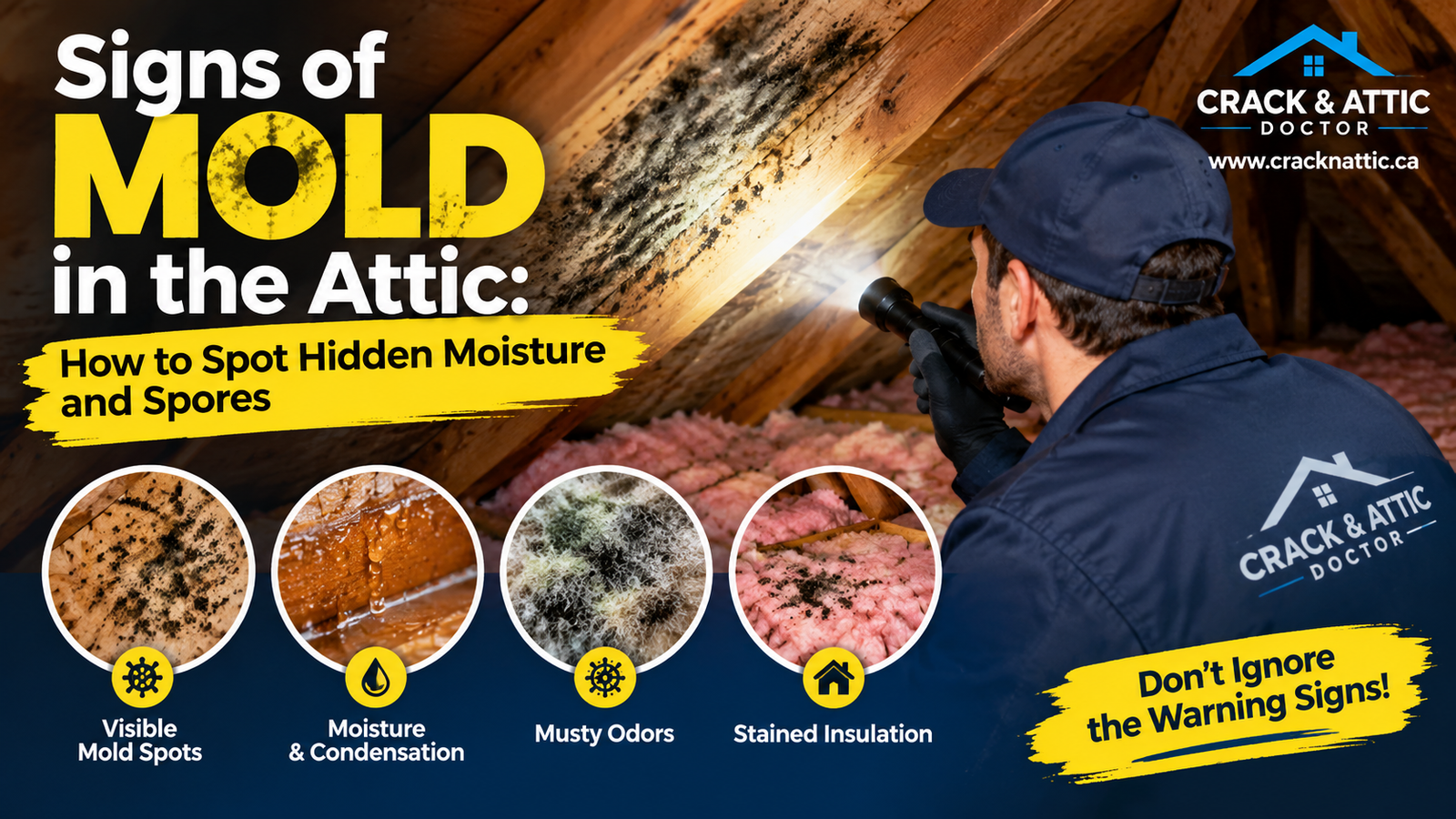
You do not need to wait for structural failure to catch a mold infestation. Grab a bright flashlight and inspect your roof cavity for these clear warning signs:
Sign 1: Dark Staining or Discoloration on Roof Sheathing
-
The Look: Black, dark brown, grey, or greenish speckling spreading across the underside of plywood or OSB roof decking, especially around north-facing slopes and roof peaks.
-
The Cause: This is active fungal colonization. As moisture condenses on the cold wood, mold spores feed on the cellulose and lignin in the wood panels.
Sign 2: Rust Rings on Roofing Nails and Metal Plates
-
The Look: Exposed roofing nail shanks protruding through the roof sheathing covered in orange rust, black staining, or white oxidation crusts.
-
The Cause: Nails are thermal bridges that conduct outside cold into the warm attic. High relative humidity condenses directly onto these cold fasteners. Rusted nails are definitive proof of chronic, elevated attic moisture.
Sign 3: Matted, Clumped, or Discolored Insulation
-
The Look: Loose-fill blown-in fiberglass or cellulose that looks compressed, crusty, discolored, or sunken in patches rather than fluffy and even.
-
The Cause: Water from roof condensation or melting frost has dripped onto the insulation. Once saturated, insulation permanently loses its air pockets and thermal resistance (R-value).
Sign 4: Persistent Musty, Earthy Odors Upstairs
-
The Look/Feel: A damp, stale, mushroom-like smell detected in upper-floor hallways, near the attic access hatch, or inside bedroom closets.
-
The Cause: Actively growing mold colonies release Microbial Volatile Organic Compounds (mVOCs). These gaseous chemicals migrate down through ceiling bypasses into your breathable living space.
Sign 5: Frost Accretion on Framing in Winter
-
The Look: White frost, ice crystals, or rime coating the roof sheathing, rafter timbers, or truss plates during sub-zero Alberta cold snaps.
-
The Cause: Escaping warm indoor humidity flash-freezes upon hitting the freezing exterior deck. When temperatures rise during a Chinook, this frost melts in an indoor downpour known as “attic rain.”
Sign 6: Water Stains or Yellow Halos on Ceilings
-
The Look: Brownish or yellow-ringed moisture marks spreading across drywall paint on the top floor, particularly around pot lights, exhaust fans, or ceiling corners.
-
The Cause: Melted attic frost has soaked completely through the insulation blanket and saturated the ceiling drywall, pulling wood tannins and dust down into the paint layer.
2. Why Calgary Attics Are a Breeding Ground for Mold
Mold requires three things to thrive: an organic food source (wood trusses, OSB sheathing, drywall paper), warmth, and moisture.
In Southern Alberta, moisture enters the roof cavity primarily through internal building envelope failures:
-
The Stack Effect (Thermal Bypasses): Daily activities like cooking, hot showers, and laundry generate gallons of water vapor. Warm, buoyant air naturally rises, escaping past unsealed pot lights, plumbing vents, electrical boxes, and attic hatches straight into the roof space.
-
Choked Soffit Intake Vents: In roughly 70% of homes, blown-in insulation spills into the roof eaves because rafter baffles were never installed. This cuts off cold, passive intake air, trapping humid air against the roof deck.
-
Disconnected or Damaged Exhaust Ducts: Bathroom and kitchen exhaust fan pipes that loosen, crack, or terminate inside the attic blow hot, saturated steam directly onto structural timbers.
-
Sub-R-60 Insulation Deficiencies: Insufficient insulation levels below Alberta Building Code R-60 standards allow conditioned room heat to warm the attic floor, creating continuous condensation cycles against the freezing roof deck.
3. The Compounding Risks of Ignoring Attic Mold
Leaving mold to spread above your ceiling creates severe structural, financial, and health consequences:
-
Indoor Air Contamination: Convective air pressure differences draw attic air downward into bedrooms. Microscopic mold spores and mycotoxins circulate into your home, aggravating asthma, chronic allergies, and sinus infections.
-
Structural Wood Rot: Wood-decay fungi soften roof sheathing, weaken engineered roof trusses, and corrode metal truss gusset plates. Spongy decking can fail completely under heavy winter snow loads.
-
Skyrocketing Heating Bills: Waterlogged insulation permanently mats down, destroying its thermal performance. Your home leaks heat, forcing your furnace to run non-stop during sub-zero winter snaps.
-
Failed Home Inspections: Undisclosed or unaddressed attic mold is one of the leading causes of collapsed real estate transactions in Alberta. Buyers and lenders demand professional, certified remediation with clearance letters before closing.
4. Why Bleach and DIY Fogging Never Work
Homeowners often try to spray household chlorine bleach on attic mold. Building science proves this makes the infestation worse:
-
Porous Wood Surface Tension: Chlorine molecules are too large to penetrate the dense cellular pores of wood framing. The chlorine stays on the surface, bleaching only the top melanin pigment.
-
Water Infiltration: Household bleach is 90% to 95% water. The water molecules penetrate deep into the wood grain, feeding the root structures (hyphae and mycelia). The mold rebounds weeks later, often stronger and more aggressive.
-
No Containment: Scrubbing dry mold without negative-air containment disperses millions of hazardous spores directly into your home’s central ventilation.
5. The Crack & Attic Doctor Solution: Certified, Permanent Cures
We do not apply cosmetic surface fixes. The Crack & Attic Doctor Solution delivers an engineered, hospital-grade building envelope cure:
-
Thermal Imaging & Moisture Mapping: We use non-invasive infrared cameras and electronic pin/pinless moisture meters to map thermal bypasses and determine the exact moisture content of roof timbers.
-
Negative Air Containment: We seal off the attic access hatch using 6-mil poly barriers and commercial zipper entries. Industrial negative air machines equipped with certified HEPA filters exhaust air outside, preventing spores from entering your home.
-
Extraction of Saturated Materials: Compromised, water-soaked, or mold-laden insulation is safely bagged within containment and removed through sealed chutes.
-
Mechanical Surface Abrasion: We use intensive HEPA vacuuming, wire brushing, and abrasive media blasting to physically extract the fungal roots from the wood grain and roof trusses.
-
Penetrating Antimicrobial & Encapsulation: We treat structural framing with hospital-grade, EPA-registered botanical and quaternary biocides. We then apply an antimicrobial coating to protect the wood from future colonization.
-
Permanent Moisture Correction: We permanently eliminate the moisture source by sealing ceiling penetrations with expanding foam, installing rafter baffles to clear soffits, and upgrading insulation to full Alberta R-60 standards through our dedicated attic mold removal and insulation replacement program.
-
Whole-Home Moisture Protection: From attic solutions to lower-level defenses against groundwater with foundation crack repair and exterior waterproofing and commercial waterproofing service Calgary systems, we safeguard your building envelope from ground to peak.
✅ Spot the Signs Early: Book Your Free Attic Mold & Moisture Audit!
Do not wait for yellow ceiling stains, sagging drywall, or respiratory issues to alert you to attic mold. Catch hidden moisture early, ensure your roof is breathing properly, and protect your home’s equity.
Contact our certified specialists today to schedule your free attic mold and moisture audit and upfront quote!
📞 Contact Southern Alberta’s Building Envelope Specialists
-
Main Office Line: (403) 633-6616 📱
-
Direct Tech Line: (587) 830-0840 📱
-
Official Website: www.cracknattic.ca 🌐
-
Email: crackandatticdoctor@gmail.com 📧
-
Office Address: #1, Second Floor – 32 Westwinds Crescent NE, Calgary, Alberta 📍
-
Proudly Serving: Calgary, Airdrie, Chestermere, Cochrane, Okotoks, High River, and nearby Southern Alberta communities.
Leave a Reply