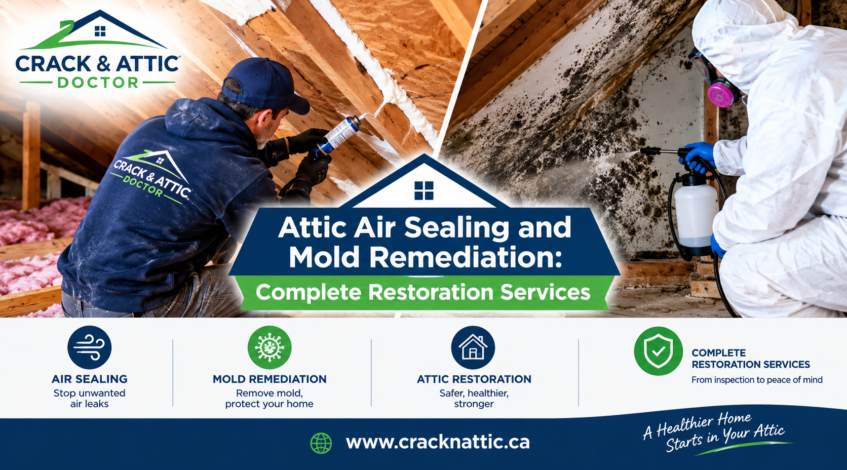
Finding mold in your attic is a serious warning sign. While many homeowners assume mold is caused by a roof leak, the real source is almost always warm, damp air escaping from the living space below.
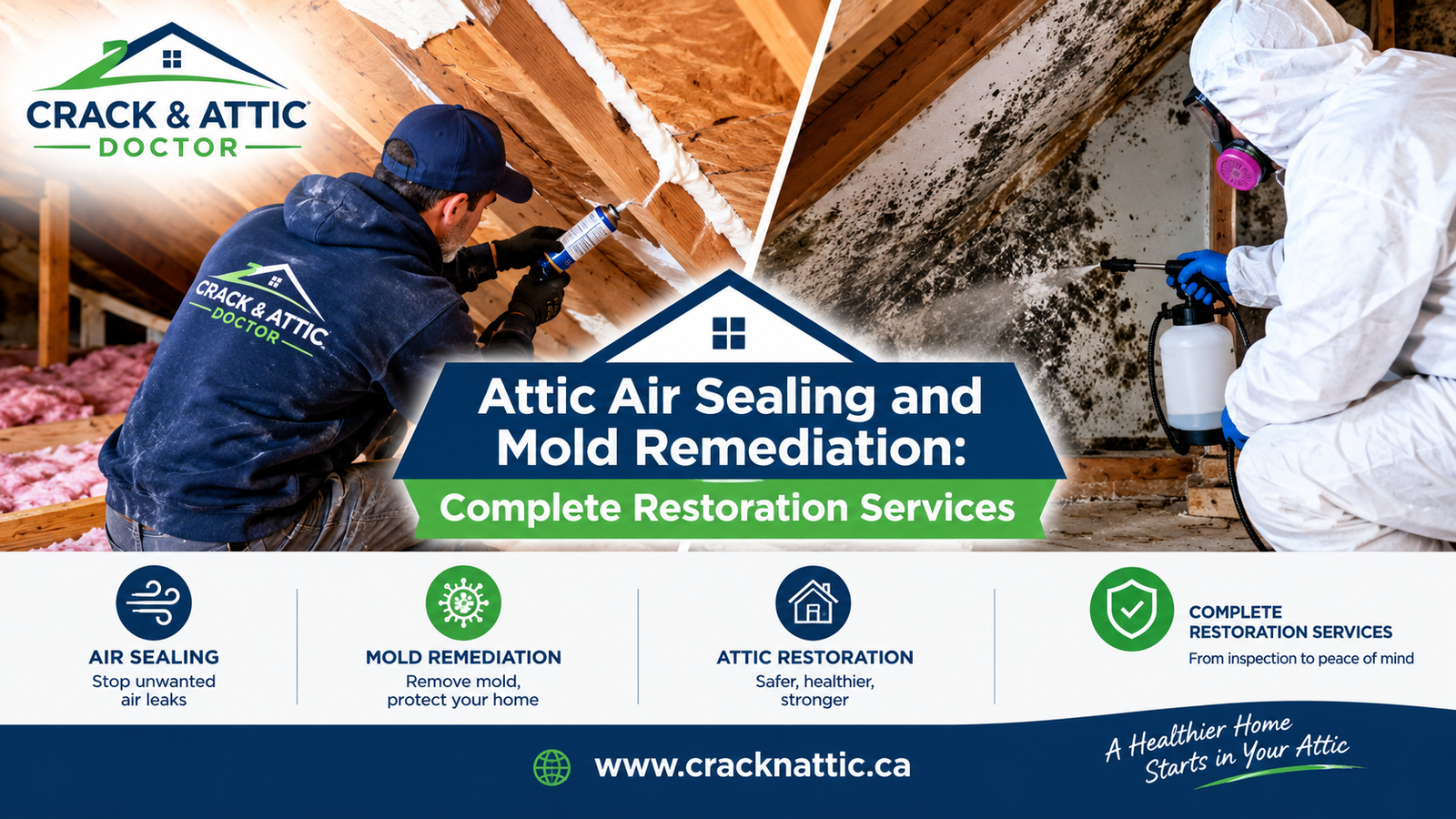
In Calgary, Airdrie, Cochrane, and Okotoks, extreme winter weather puts heavy strain on the building envelope. Daily activities like showering, cooking, and doing laundry pump gallons of moisture into your indoor air. Because warm air rises naturally, it slips through unsealed ceiling gaps directly into your freezing attic. Consequently, that trapped moisture condenses on cold roof sheathing, triggering thick frost, structural decay, and aggressive fungal growth.
Simply scraping mold off wood framing does not solve the root problem. Without permanent air barrier protection, mold will return during the next cold snap.
At Crack & Attic Doctor, our attic air sealing and mold remediation program provides a complete restoration service. We safely extract active fungal colonies, seal all thermal bypasses, and upgrade insulation so your attic stays clean, dry, and energy-efficient.
1. Why Air Sealing and Mold Remediation Must Go Together
Treating mold as an isolated cleaning job is a common mistake. If you scrub the wood but leave air leaks open, warm moisture will continue to rise into the attic.
True restoration requires two essential steps:
-
Certified Mold Remediation: Technicians must isolate the attic, eliminate active fungal roots from roof sheathing and trusses, and purify the air using HEPA filtration.
-
Precision Air Sealing: Contractors must seal every ceiling gap with expanding closed-cell foam to lock warm, humid air inside the living space where it belongs.
Without comprehensive air sealing, warm air will hit freezing roof boards every winter. Therefore, effective remediation always combines mechanical mold removal with a permanent air barrier.
2. How the Stack Effect Causes Winter “Attic Rain”
Calgary attics face a major winter issue known as attic rain. This problem is driven by a natural physical process called the stack effect:
-
Warm Air Escape: Heated indoor air is light and buoyant. As a result, it rises toward your top floor and pushes against the ceiling plane.
-
Thermal Bypasses: That warm air finds every unsealed opening, including gaps around pot lights, plumbing vent stacks, electrical wiring, and attic access hatches.
-
Frost Accumulation: During sub-zero Alberta winters, plywood and OSB roof sheathing drop well below freezing. When moist air escapes through ceiling gaps, it hits cold wood and flash-freezes into thick rime frost.
-
The Chinook Thaw: When a warm Chinook wind blows into town, attic temperatures spike above freezing in hours. Consequently, that built-up frost melts instantly, pouring water through insulation and creating yellow water stains on ceiling drywall.
-
Rapid Mold Growth: The damp, warm conditions left behind by melting frost create the perfect environment for mold spores to germinate and spread across wood rafters within 24 to 48 hours.
3. Top Ceiling Air Leaks Sealed During Restoration
During an attic restoration, our technicians locate and seal critical leakage points across your ceiling plane:
-
Attic Access Hatches: Unsealed, uninsulated attic hatches allow large amounts of heat and moisture to pour straight into the roof space.
-
Recessed Pot Lights: Standard ceiling fixtures without airtight vapor boots act like open chimneys for warm air.
-
Plumbing Vent Stacks: Open chases around sewer and vent pipes create wide pathways that channel basement and bathroom moisture to the roof.
-
Electrical Wire Penetrations: Small holes drilled through top wall plates for wiring allow steady streams of heated air to escape.
-
Bathroom Fan Housings: Gaps around exhaust fan boxes leak steam directly into the attic before it reaches the vent duct.
-
Partition Wall Top Plates: Drywall joints along interior walls often have hidden cracks that let conditioned air leak into the attic floor.
4. The Crack & Attic Doctor 6-Step Restoration Process
As certified building envelope and mold remediation specialists, we follow strict IICRC S520 protocols to ensure safe, permanent results:
-
Infrared Thermal & Moisture Diagnostics: First, we use infrared thermal cameras and digital moisture meters to locate hidden air leaks and damp framing without destructive testing.
-
Negative-Air Containment: Next, we seal the attic hatch with heavy 6-mil plastic sheeting and zipper doors. We run industrial HEPA negative-air machines to prevent spores from entering your living areas.
-
Extraction of Damaged Insulation: If the current insulation is waterlogged, compressed, or contaminated with mold, we vacuum it directly into exterior disposal bags.
-
Mechanical Wood Scrubbing: We physically clean structural roof decking, trusses, and joists using HEPA vacuums and abrasive wire brushing to remove fungal roots from the wood grain.
-
Antimicrobial Treatment & Sealing: Afterwards, we apply hospital-grade, EPA-registered biocides to kill remaining spores. Then, we apply an antimicrobial coating to protect the wood against future moisture.
-
Air Sealing & R-60 Insulation Upgrades: Finally, we seal all ceiling penetrations with expanding foam, install rafter baffles along the eaves to clear soffits, and blow in fresh insulation to Alberta’s R-60 standard through our attic mold removal and insulation replacement service.
5. Professional Restoration vs. Surface Cleaning
| Service Feature | Basic Surface Cleaners | Crack & Attic Doctor Full Service |
| Containment Protocol | None; spreads spores into bedrooms | Full 6-mil poly containment and HEPA negative air |
| Root Extraction | Surface sprays that leave deep roots intact | Deep mechanical extraction and antimicrobial sealing |
| Air Sealing | Skipped completely | Complete penetration sealing with closed-cell foam |
| Ventilation Checks | Ignored | Full rafter baffle installation and airflow balancing |
| Insulation Upgrades | Leaves wet, compressed insulation in place | Full extraction and top-up to Alberta R-60 depth |
| Real Estate Clearance | No documentation | Certified transferable clearance letters for home sales |
| Building Envelope Scope | Limited to roof sprays | Complete home care, including foundation crack repair and exterior waterproofing |
6. Signs Your Attic Needs Air Sealing and Remediation
Watch for these warning signs that indicate your attic requires professional attention:
-
Dark Stains on Roof Sheathing: Black, grey, or dark brown patches spreading across roof plywood or rafters.
-
Yellow Ceiling Halos: Brown or yellow water stains forming around ceiling lights or drywall joints during winter thaws.
-
Rusted Roofing Nails: Orange rust or white oxidation crusts on nails poking through the roof deck.
-
High Winter Heating Bills: High energy bills caused by continuous heat loss through an unsealed ceiling plane.
-
Musty Odors Upstairs: A persistent damp, earthy smell in upper-floor hallways or bedrooms.
-
Cold Upper Floors: Drafty bedrooms and cold ceilings caused by missing insulation and air bypasses.
✅ Book Your Complete Attic Restoration Today!
Do not allow hidden air leaks to feed toxic attic mold, ruin your insulation, or damage your home’s structural framing.
Protect your property with Southern Alberta’s trusted building envelope specialists. Contact our team today to schedule your comprehensive attic air sealing audit, mold inspection, and upfront quote!
📞 Contact Southern Alberta’s Building Envelope Specialists
-
Main Office Line: (403) 633-6616 📱
-
Direct Tech Line: (587) 830-0840 📱
-
Official Website: www.cracknattic.ca 🌐
-
Email: crackandatticdoctor@gmail.com 📧
-
Office Address: #1, Second Floor – 32 Westwinds Crescent NE, Calgary, Alberta 📍
-
Proudly Serving: Calgary, Airdrie, Chestermere, Cochrane, Okotoks, High River, and nearby Southern Alberta communities.
Leave a Reply