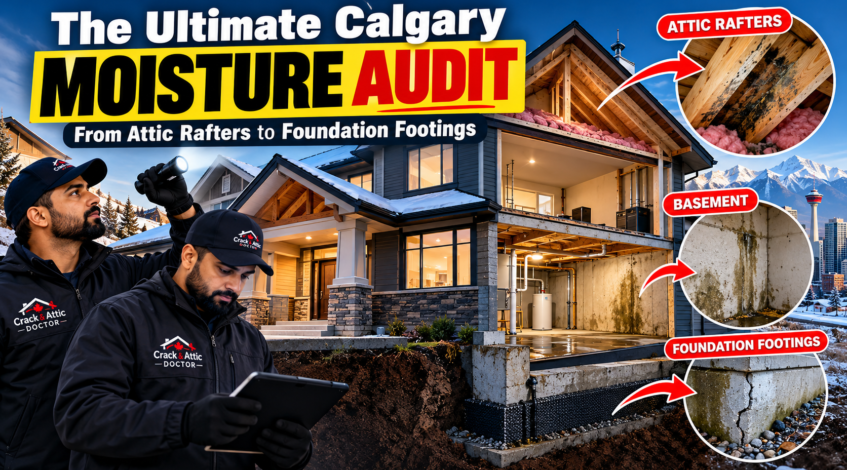
A home does not fail in isolated sections. It behaves as a continuous, dynamic unit known as the building envelope. When moisture enters at the foundation or condenses in the roof deck, the entire ecosystem of your home is compromised.
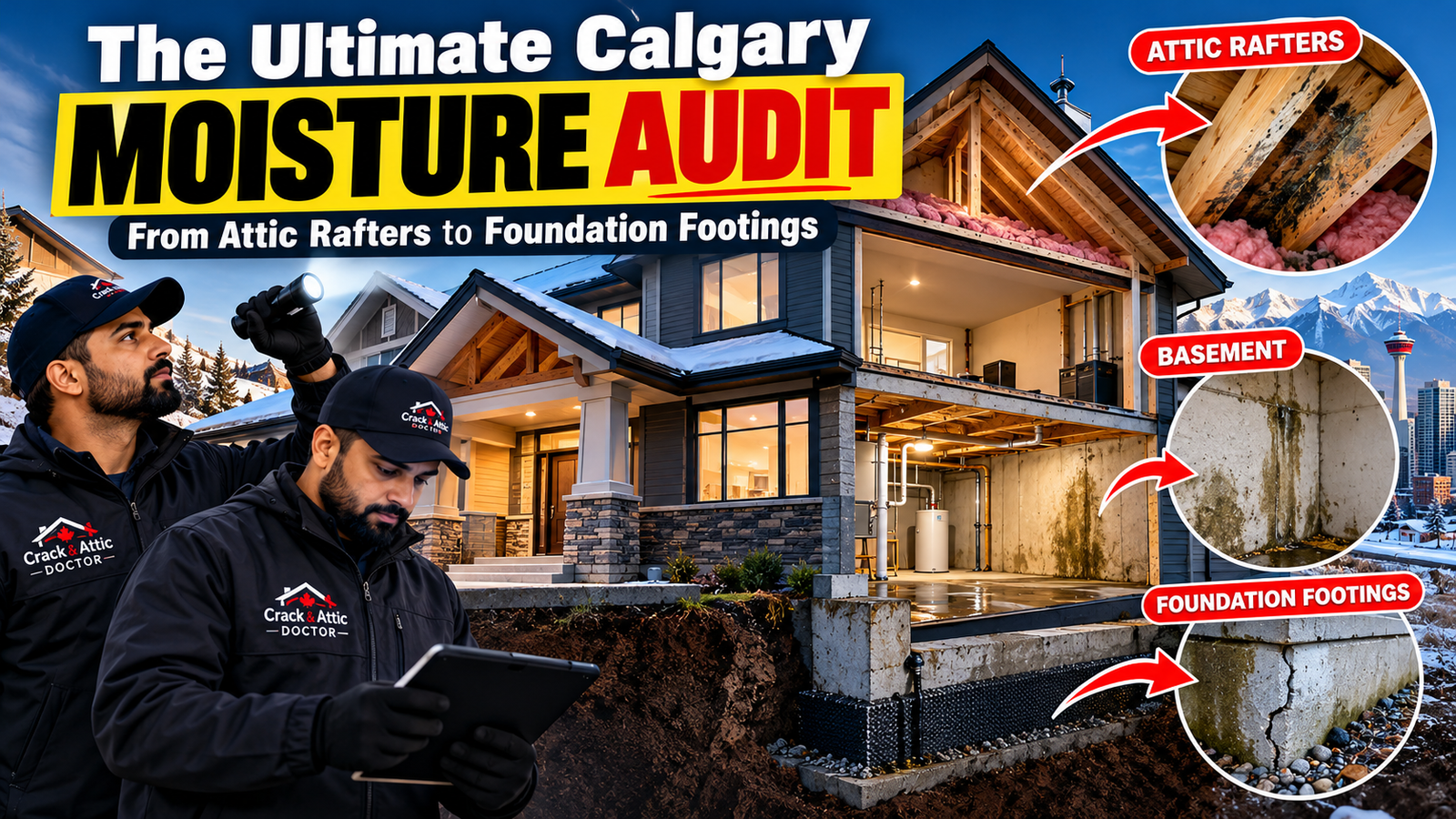
In Southern Alberta, our climate subjects homes to extreme physical stress. Dense clay soil expands against basement walls during seasonal downpours, while rapid winter Chinook swings drive indoor condensation straight into freezing roof spaces.
Treating a wet basement wall without evaluating your home’s air pressure—or wiping down attic mold without checking structural ventilation—addresses only surface symptoms.
The Ultimate Calgary Moisture Audit by Crack & Attic Doctor takes a comprehensive approach. We analyze your property from top to bottom, mapping every path where air, water, and heat escape or infiltrate.
1. The Stack Effect: How Basements and Attics Connect
Moisture migration in Calgary homes follows a predictable law of building science called the stack effect. Your house operates like a large thermal chimney:
-
Foundation Ground Infiltration: During spring and autumn rainstorms, expansive clay soil swells, generating heavy lateral hydrostatic pressure against concrete walls. Groundwater forces through settling cracks, cold joints, and porous masonry, raising the ambient relative humidity of the lower levels.
-
The Convective Updraft: As the heating system runs, warm air naturally expands and rises through stairwells, interior partition walls, and plumbing chases. It carries this elevated basement moisture upward into your main living quarters.
-
The Attic Dew-Point Collision: The warm, humid air searches for any unsealed ceiling penetration—around pot lights, electrical boxes, bathroom exhaust fans, and attic hatches. When it enters the unconditioned attic and strikes freezing exterior roof sheathing, it turns into frost. During a rapid Chinook thaw, that frost melts instantly, triggering an indoor flood known as “attic rain.”
Inspecting only the rafters or only the basement footings leaves half of the moisture cycle unaddressed. A true building envelope audit examines both ends of the convective loop.
2. Phase 1: The Attic Rafter & Roof Deck Audit
The upper boundary of your building envelope is your home’s thermal and moisture buffer. During the attic portion of the audit, our technicians inspect four critical components:
A. Non-Invasive Infrared Thermal Bypass Mapping
Using high-resolution FLIR infrared imaging, we identify thermal bridges and convective bypasses across the ceiling plane. These scans pinpoint unsealed penetrations where conditioned interior heat and humidity leak into the unconditioned roof cavity.
B. Net Free Ventilation Area (NFVA) Calculations
Balanced airflow requires continuous intake and exhaust. We calculate the exact ratio of intake soffit venting to high-point roof exhaust (such as ridge vents or static box vents) according to the Alberta Building Code. We verify that intake soffits are not choked by loose-fill insulation and that rigid rafter baffles are installed along every truss bay.
C. Thermal Resistance & Insulation Integrity
We measure insulation depth to confirm compliance with modern Alberta R-60 standards (~18 to 22 inches of blown-in fiberglass or cellulose). We check for clumping, compaction, and loss of thermal R-value caused by prior attic rain or moisture saturation.
D. Structural Wood Decking & Fastener Screening
We test plywood and OSB roof sheathing, rafters, and engineered trusses using calibrated pinless and pin-type moisture meters. We inspect exposed roofing nails for rust rings, dark wood staining, and active fungal colonization requiring hospital-grade remediation.
3. Phase 2: The Foundation Footing & Basement Wall Audit
The lower boundary of your building envelope anchors the structure and withstands continuous soil hydrology. During the foundation audit, we evaluate three major vulnerability zones:
A. Structural Concrete Fracture Diagnostics
Concrete shrinks, cures, and moves under load. We assess every visible fissure to differentiate between superficial hairline drying cracks and active structural threats:
-
Horizontal Cracks: Mid-wall lateral cracks caused by severe lateral hydrostatic soil pressure and inward wall displacement.
-
Stair-Step Cracks: Diagonal step patterns tracking through mortar joints, caused by differential footing settlement in shifting clay soil.
-
Vertical Leaking Cracks: Shear cracks that penetrate the full wall thickness and allow active water seepage.
B. Deep Subsurface Moisture Profiling
Using electronic moisture meters, we scan finished drywall, bottom wood plates, and exposed concrete to detect hidden dampness behind framed walls before rot or mold shows up on the surface. We check for white powdery efflorescence, which confirms continuous moisture migration through the concrete.
C. Exterior Grading & Hydrology Evaluation
Water management begins outside. We review perimeter backfill grading, window well depth and drainage, and downspout discharge distances to ensure surface water is directed safely away from the foundation footings.
4. Attic vs. Foundation Moisture: Diagnostic Comparison
| Inspection Phase | Attic Rafters & Roof Cavity | Foundation Walls & Footings |
| Primary Moisture Source | Warm rising indoor air, stack effect, and Chinook attic rain | Expansive clay soil saturation and lateral hydrostatic pressure |
| Key Risk Factors | Choked soffit vents, missing air seals, sub-R-60 insulation | Foundation settling cracks, improper grading, clogged weeping tiles |
| Structural Consequences | Delaminated roof sheathing, truss dry rot, rusted gusset plates | Wall bowing, spalling concrete, corroded internal steel rebar |
| Indoor Living Impact | Water-stained ceiling drywall, ruined insulation, mold spores | Saturated carpets, ruined finished basements, musty air quality |
| Permanent Remediation | Precision air sealing, rafter baffles, R-60 blown-in insulation | High-pressure commercial polyurethane injection, perimeter drainage |
5. The Crack & Attic Doctor Solution: Total Envelope Cures
When structural moisture problems are discovered, we do not apply superficial patches like store-bought silicone or bleach. The Crack & Attic Doctor Solution delivers permanent, engineered building envelope fixes:
-
High-Pressure Polyurethane Crack Injections: We inject commercial-grade hydrophobic polyurethane resin deep into basement fractures under high pressure. The resin reacts with existing moisture, expanding up to 20 times its volume to form an elastomeric, watertight seal across the full 8-to-10-inch concrete wall.
-
Precision Attic Air Sealing: We use closed-cell expanding foam to seal all ceiling bypasses—around pot lights, plumbing vent pipes, electrical boxes, and attic access hatches—locking conditioned air inside your living space.
-
Ventilation Clearing & Rafter Baffle Installation: We pull back compacted insulation from the roof eaves and install heavy-duty rafter baffles, establishing continuous intake airflow from the soffits up to the roof vents.
-
Certified HEPA Mold Remediation: If trapped condensation has sparked mold colonies, we isolate the space under negative air pressure, extract contaminated materials, apply EPA-registered antimicrobial biocides, and scrub the air with industrial HEPA filtration systems.
-
Alberta Code R-60 Blown-In Insulation Upgrades: We replace compacted or damp insulation with premium, high-density blown-in insulation to restore proper thermal resistance, eliminate drafts, and reduce heating costs.
-
Complete Building Envelope Security: From attic restoration to basement foundation crack repair and exterior waterproofing and our comprehensive attic mold removal and insulation replacement services, we protect your entire home against structural water damage.
✅ Book Your Complete Calgary Moisture Audit Today!
Do not wait for a collapsed ceiling or flooded basement to reveal building envelope failures. Stop hidden moisture, prevent attic rain, seal foundation cracks, and protect your home equity.
Contact our certified specialists today to schedule your Ultimate Calgary Moisture Audit and clear, upfront quote!
📞 Contact Southern Alberta’s Building Envelope Specialists
-
Main Office Line: (403) 633-6616 📱
-
Direct Tech Line: (587) 830-0840 📱
-
Official Website: www.cracknattic.ca 🌐
-
Email: crackandatticdoctor@gmail.com 📧
-
Office Address: #1, Second Floor – 32 Westwinds Crescent NE, Calgary, Alberta 📍
-
Proudly Serving: Calgary, Airdrie, Chestermere, Cochrane, Okotoks, High River, and nearby Southern Alberta communities.
Leave a Reply