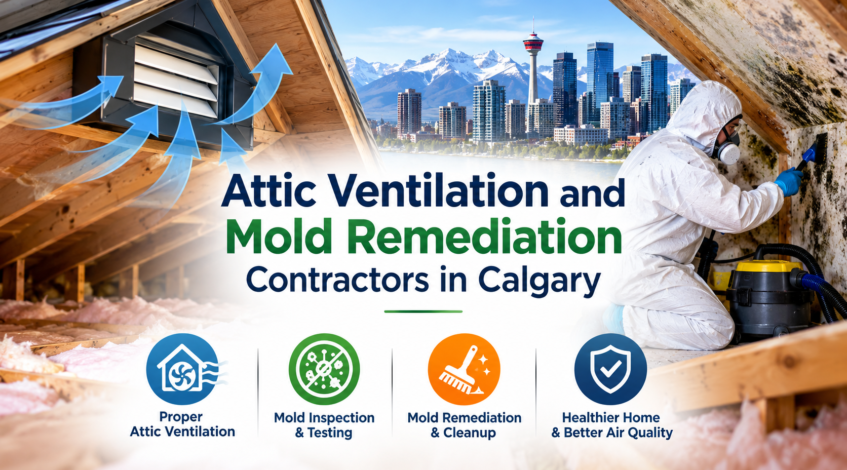
Finding mold in your attic is an alarming discovery for any homeowner. However, mold is usually just a symptom of a deeper mechanical problem. In most cases, the real culprit is poor attic ventilation combined with trapped moisture.
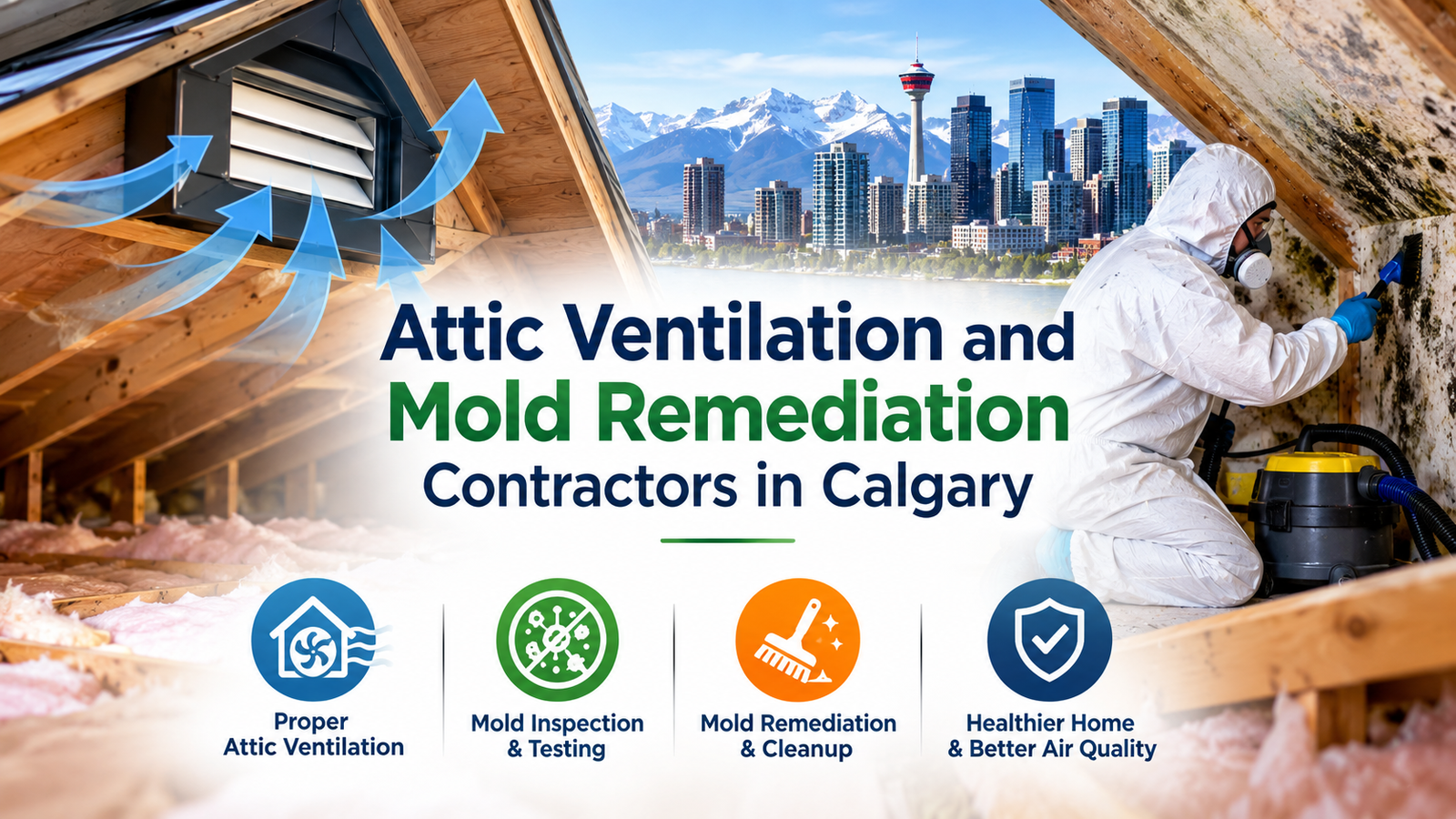
In Calgary, our extreme winter weather puts heavy stress on residential roof spaces. Sub-zero temperatures, intense freeze-thaw cycles, and warm Chinook winds quickly expose building envelope flaws. When warm indoor air leaks into a cold, unvented roof cavity, moisture condenses on the roof deck. As a result, toxic mold colonies spread across your wood framing in as little as 48 hours.
Hiring generic cleaners who merely spray surface chemicals will not solve the issue. Instead, you need certified attic ventilation and mold remediation contractors in Calgary who fix both the active mold and the airflow failure that caused it.
At Crack & Attic Doctor, we provide full building envelope solutions. We extract hazardous spores safely, balance your roof airflow, and seal air leaks so your attic stays clean and dry permanently.
1. Why Attic Ventilation and Mold Remediation Belong Together
Many homeowners try to treat mold as an isolated cleaning job. However, wiping down wood sheathing without fixing your attic airflow guarantees that the fungus will return.
In Southern Alberta, proper roof care requires a two-part approach:
-
Certified Mold Eradication: First, technicians must safely remove the existing fungal roots from structural wood timbers using negative-air containment and HEPA filtration.
-
Ventilation Correction: Next, contractors must restore balanced passive airflow. This step ensures that future moisture flushes out of the roof cavity before it can condense.
Without balanced ventilation, humidity accumulates against the roof sheathing every winter. Therefore, true remediation always pairs structural mold removal with ventilation upgrades.
2. How Poor Airflow Triggers Calgary “Attic Rain”
Calgary roofs face a unique winter challenge known as attic rain. This problem stems directly from poor air sealing and restricted ventilation.
Here is how the cycle unfolds:
-
Rising Moisture (The Stack Effect): Everyday activities like showering, cooking, and doing laundry create gallons of water vapor. Because warm air is light, it rises naturally toward the ceiling. Then, it slips through unsealed gaps around pot lights, plumbing stacks, and the attic hatch.
-
Winter Frost Buildup: During cold winter snaps, roof plywood stays well below freezing. When warm indoor air hits this cold surface, it turns into thick frost. If your intake vents are blocked, that moisture has nowhere to escape.
-
The Chinook Meltdown: When warm Chinook winds sweep through Calgary, attic temperatures jump above freezing within hours. Consequently, that built-up frost melts rapidly, raining gallons of water down into your insulation and ceiling drywall.
-
Rapid Mold Colonization: Because the attic space remains warm and damp after the thaw, dormant mold spores germinate quickly. Consequently, wood trusses, OSB decking, and drywall paper become covered in dark fungal colonies.
3. Common Ventilation Mistakes in Local Homes
During our attic inspections across Calgary, Airdrie, and Cochrane, our team regularly finds three widespread ventilation errors:
Mistake 1: Choked Soffit Intake Vents
Roughly 70% of homes suffer from blocked soffits. When older insulation shifts or new insulation is blown in without protective baffles, loose material spills into the eaves. As a result, fresh outdoor air cannot enter the attic, which shuts down cross-ventilation entirely.
Mistake 2: Uncut Soffit Panels
In many homes, siding crews install perforated metal soffit covers directly over solid wood eaves without cutting intake holes first. Although the panels look vented from the street, solid wood behind them blocks all incoming air.
Mistake 3: Exhaust Fan Duct Dumps
Bathroom exhaust fans must vent directly outdoors through dedicated roof caps. However, contractors frequently find exhaust pipes that terminate inside the attic or point directly into soffit vents. Consequently, every hot shower pumps dense humidity straight into the roof framing.
4. The Crack & Attic Doctor 6-Step Restoration Process
As certified building envelope and remediation specialists, we follow strict IICRC S520 protocols to protect your home and air quality:
-
Thermal Imaging & Moisture Mapping: First, we inspect your attic with infrared cameras and digital moisture meters to find hidden thermal bypasses and damp framing.
-
Negative Air Containment: Next, we seal the attic access opening with 6-mil plastic barriers and zipper entries. We run commercial negative air machines with medical-grade HEPA filters to keep spores from entering your living areas.
-
Safe Insulation Removal: If current insulation is wet, matted, or contaminated with mold, we extract it using high-powered vacuums routed directly outside.
-
Mechanical Wood Cleaning: We physically scrub structural trusses and roof sheathing using HEPA vacuums and abrasive wire brushing to strip away fungal roots.
-
Antimicrobial Treatment: Afterwards, we apply hospital-grade, EPA-registered biocides to eliminate remaining spores. Then, we coat the timbers with a mold-resistant sealant.
-
Airflow Balancing & R-60 Insulation: Finally, we install rigid rafter baffles along the eaves to clear choked soffits, seal ceiling bypasses with expanding foam, and blow in fresh insulation to Alberta’s R-60 standard through our attic mold removal and insulation replacement service.
5. Professional Contractors vs. General Cleaners
| Service Feature | General Handyman / Cleaners | Crack & Attic Doctor Specialists |
| Containment Protocol | None; spreads spores into bedrooms | Full 6-mil poly containment & HEPA negative air |
| Root Treatment | Surface bleach that leaves roots intact | Deep mechanical extraction and antimicrobial sealing |
| Ventilation Diagnostics | Ignored completely | Full Net Free Vent Area (NFVA) airflow calculations |
| Insulation Handling | Covers up wet, compressed material | Safe extraction and top-up to Alberta R-60 depth |
| Real Estate Documentation | No formal documentation | Certified transferable clearance letters for home sales |
| Building Envelope Scope | Limited to visible spray work | Complete care, including foundation crack repair and exterior waterproofing |
6. Signs You Need an Attic Contractor Immediately
You should contact a qualified attic specialist if you spot any of the following warning signs:
-
Dark Speckling on Roof Sheathing: Black or grey discoloration spreading across plywood or truss timbers.
-
Rusted Roofing Nails: Orange rust or white crust on exposed nails protruding through the roof deck.
-
Yellow Ceiling Halos: Water stains spreading across upper-floor drywall after a winter thaw.
-
Musty Smells Upstairs: A damp, earthy odor lingering in top-floor bedrooms or closets.
-
Pending Home Sales: Attic mold noted on a buyer’s home inspection report requiring immediate clearance.
✅ Book Your Calgary Attic Inspection Today!
Do not allow poor ventilation and hidden mold to damage your roof framing, lower your energy efficiency, or threaten your family’s health.
Protect your property with Calgary’s trusted building envelope specialists. Contact our team today to schedule your comprehensive attic ventilation audit, mold inspection, and clear estimate!
📞 Contact Southern Alberta’s Building Envelope Specialists
-
Main Office Line: (403) 633-6616 📱
-
Direct Tech Line: (587) 830-0840 📱
-
Official Website: www.cracknattic.ca 🌐
-
Email: crackandatticdoctor@gmail.com 📧
-
Office Address: #1, Second Floor – 32 Westwinds Crescent NE, Calgary, Alberta 📍
-
Proudly Serving: Calgary, Airdrie, Chestermere, Cochrane, Okotoks, High River, and nearby Southern Alberta communities.
Leave a Reply