It is easy to look at a thin hairline crack in your basement wall and decide to deal with it next spring. After all, it is just a tiny gap, and the basement is not currently flooding.
However, in Southern Alberta, putting off concrete repair before winter is one of the most expensive gambles a homeowner can take.
In Calgary, Airdrie, Cochrane, and Okotoks, winter weather does not gently settle in. Instead, our climate is defined by brutal freeze-thaw swings, heavy snow accumulation, and sudden Chinook thaws.
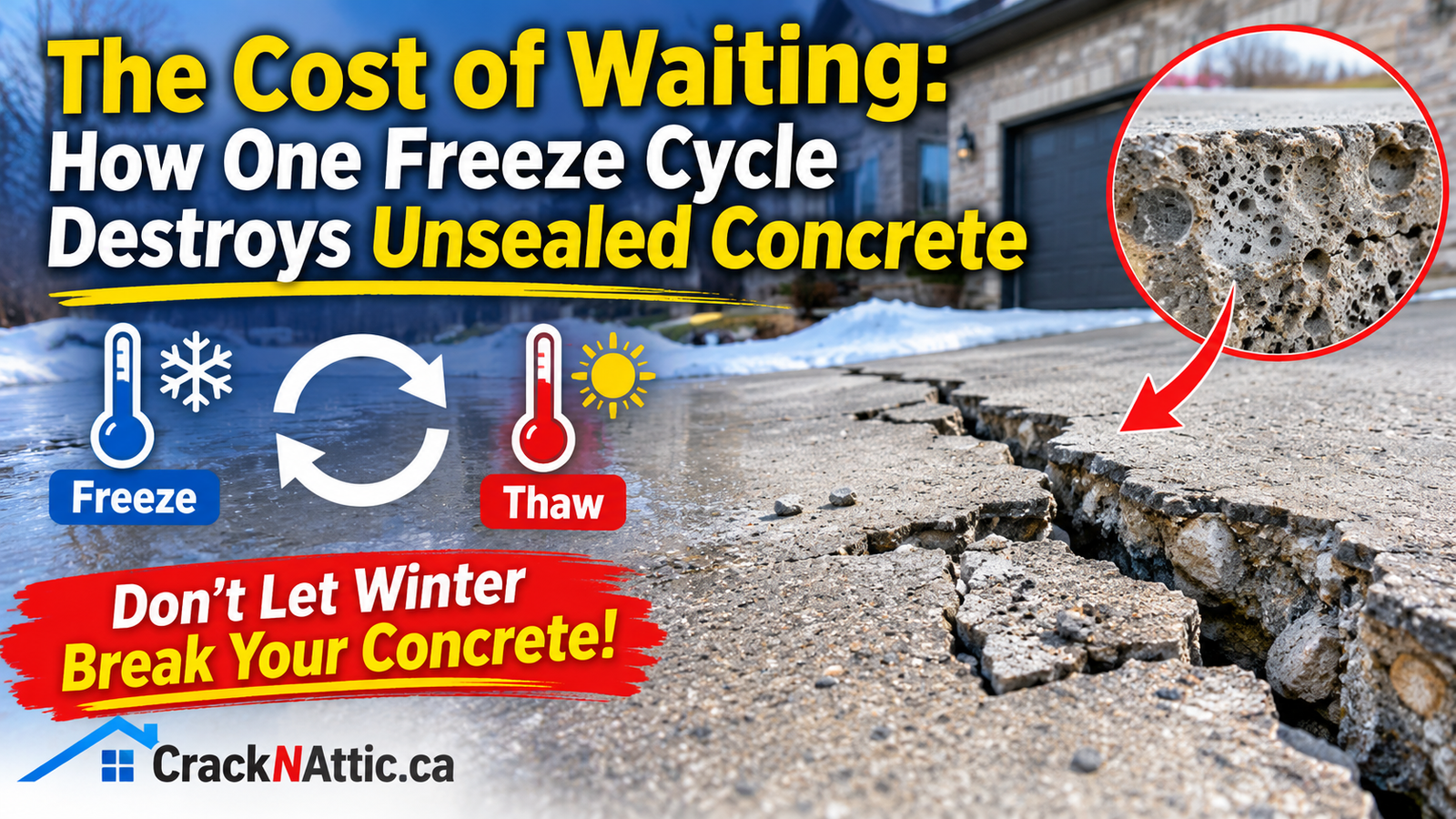
When water seeps into unsealed concrete pores and freezes, it behaves like a mechanical chisel. In fact, a single freeze cycle can transform a minor settling fracture into a major structural failure.
Understanding how freezing water destroys concrete, what waiting costs your wallet, and how the Crack & Attic Doctor Solution seals your home permanently will help protect your investment this winter.
1. The Physics of the Freeze: The 9% Hydraulic Wedge
Concrete looks solid, but under a microscope, it acts like a rigid, porous sponge. It is filled with microscopic capillaries, air pockets, and curing micro-fissures.
During autumn rains and early snowfalls, groundwater from Calgary’s dense, expansive clay soil saturates these concrete capillaries. Then, sub-zero winter temperatures arrive.
Here is how a single freeze cycle causes catastrophic damage:
-
The Volumetric Expansion: When liquid water freezes into ice, its physical volume expands by roughly 9%.
-
Hydraulic Frost Pressure: Because concrete cannot stretch, expanding ice crystals generate immense hydraulic pressure inside the pore network. This internal pressure often exceeds 30,000 pounds per square inch (psi)—far higher than the standard 3,000 to 4,000 psi compressive strength of residential poured concrete.
-
Micro-Spalling & Cleaving: This internal force shears the cement paste away from aggregate stones. Consequently, the concrete splits open, turning microscopic hairline drying fissures into wide, through-wall fractures.
-
The Thaw Cycle Re-Entry: When daytime temperatures rise or a warm Chinook wind blows across Alberta, the ice melts. The newly widened gap allows a much larger volume of groundwater to flow deeper into the foundation wall.
-
The Second Freeze: When the temperature plunges again that night, the cycle repeats with even greater destructive force.
2. Compounding Damage: What Happens Inside an Unsealed Wall
The damage does not stop at cracked concrete. When water penetrates deep into an unsealed foundation wall over the winter, it triggers a chain reaction of structural decay:
-
Internal Steel Rebar Corrosion: Water reaching interior reinforcing steel rebar causes the metal to oxidize and rust. Because rusting steel expands up to four times its original diameter, it cracks the concrete from the inside out, a destructive process known as delamination and spalling.
-
Basement Flooding During Chinook Thaws: Sudden temperature swings rapidly melt yards of snow while the surrounding topsoil remains frozen solid. Surface runoff tracks directly along basement walls, pouring through widened concrete cracks and ruining subfloors, carpets, and drywall.
-
Rapid Mold Colonization: Water pooling behind finished basement framing and insulation creates an ideal feeding ground for mold. In fact, toxic mold colonies germinate on damp drywall backing within 24 to 48 hours.
-
Loss of Lateral Shear Strength: Foundation walls withstand thousands of pounds of lateral soil pressure. As freeze-thaw cycles break the integrity of the concrete, walls can begin to shear, deflect, and bow inward.
3. The Real Cost: Fall Prevention vs. Mid-Winter Emergency
Postponing foundation crack repair does not save money. Instead, it multiplies your eventual repair costs by four to ten times.
| Diagnostic & Repair Stage | Pre-Freeze Autumn Repair | Mid-Winter Emergency / Post-Thaw Flood |
| Repair Method | Targeted high-pressure polyurethane injection | Emergency extraction, interior demolition & deep crack structural stabilization |
| Living Disruption | Clean, targeted repair completed in a few hours | Tearing out finished drywall, ripping up carpets, running loud commercial dehumidifiers |
| Secondary Hazards | None; seals water completely out of the wall | Active toxic mold growth, framing rot, rusted furnace bases, ruined furniture |
| Property Resale Impact | Transferable warranty and clean inspection report | Mandatory property disclosure of basement water damage and structural repairs |
| Financial Cost | A few hundred dollars (low, fixed cost) | Thousands to tens of thousands of dollars in restoration |
4. Warning Signs Your Concrete Needs Repair Before the Freeze
Before the ground freezes solid, walk your basement perimeter with a bright light and check for these critical warning signs:
-
Hairline Cracks Wider Than a Fingernail: Any crack measuring over 1/16 inch (1.5 mm) is wide enough to take on water and split during a freeze.
-
Efflorescence (White Chalky Powder): White mineral salt crusts along basement walls prove that groundwater is actively seeping through the concrete pores and evaporating inside.
-
Damp Spots or Cold Joints: Discolored patches along lower walls or at the seam where the concrete wall meets the basement floor slab indicate active moisture penetration.
-
Musty Odors: A persistent earthy, stale odor in your basement indicates hidden moisture trapped behind insulation or baseboards.
5. Why Surface Caulk and DIY Hydraulic Cement Fail
Many homeowners attempt to patch basement cracks with hardware store silicone, hydraulic cement, or surface epoxy pastes. Unfortunately, these DIY patches fail under winter conditions for three reasons:
-
Surface-Only Coverage: Surface patches cover only the inner 1/4 inch of the wall. Meanwhile, the outer 7 to 9 inches of concrete remains completely exposed to freezing water and expanding ice wedges.
-
Brittle Rigidity: Hydraulic cement and standard epoxy dry completely rigid. As the house shifts and temperatures swing, rigid surface patches snap off and crumble.
-
Trapped Water Behind the Patch: Water continues to fill the crack from the outside. When it freezes behind the surface patch, it pops the caulk off the wall and shears more concrete away.
6. The Crack & Attic Doctor Solution: High-Pressure Polyurethane Injections
Permanent foundation repair requires sealing the entire depth of the wall with an elastomeric barrier that moves naturally with concrete.
The Crack & Attic Doctor Solution delivers an engineered, permanent fix:
-
Diagnostic Moisture Scanning: First, we use infrared thermal cameras and electronic moisture meters to map the exact path of the fissure and detect hidden moisture behind finished walls.
-
High-Pressure Injection Port Placement: Next, we drill mechanical injection ports at 45-degree angles along the crack path to intersect the fracture in the center of the concrete wall.
-
Full-Depth Polyurethane Injection: We inject commercial-grade hydrophobic polyurethane resin under high pressure. The resin reacts with existing moisture, expanding up to 20 times its original volume to fill every micro-void across the entire 8- to 10-inch concrete wall.
-
Permanent Elastomeric Flexibility: Unlike brittle cement or epoxy, cured polyurethane remains permanently flexible. It stretches and contracts with seasonal ground movement, ensuring a watertight seal through every freeze-thaw cycle.
-
Complete Building Envelope Defense: From basement concrete security to exterior systems like foundation crack repair and exterior waterproofing and roof-level attic mold removal and insulation replacement, we protect your home against structural water damage from top to bottom.
✅ Do Not Let One Freeze Cycle Destroy Your Foundation!
Do not wait for a winter freeze to turn a minor concrete crack into an expensive basement flood. Secure your foundation, protect your finished basement, and enjoy complete peace of mind this winter.
Contact our certified specialists today to schedule your pre-winter foundation inspection and clear, upfront quote!
📞 Contact Southern Alberta’s Building Envelope Specialists
-
Main Office Line: (403) 633-6616 📱
-
Direct Tech Line: (587) 830-0840 📱
-
Official Website: www.cracknattic.ca 🌐
-
Email: crackandatticdoctor@gmail.com 📧
-
Office Address: #1, Second Floor – 32 Westwinds Crescent NE, Calgary, Alberta 📍
-
Proudly Serving: Calgary, Airdrie, Chestermere, Cochrane, Okotoks, High River, and nearby Southern Alberta communities.