Finding dark specks in your home is always unsettling. Whether it shows up on attic roof sheathing, along basement baseboards, or in shower grout, your first thought is almost certainly: “Is this toxic black mold, or is it just harmless surface mildew?”
In Calgary, Airdrie, Cochrane, and Okotoks, this distinction is critical. Our region’s cold winters, dry outdoor air, and swift Chinook freeze-thaw cycles create extreme moisture traps inside residential building envelopes.
While surface mildew is an easily cleanable cosmetic nuisance, toxic black mold (Stachybotrys chartarum) eats deep into structural building materials. Left unchecked, it releases harmful mycotoxins into your indoor air and damages the wood framing of your home.
Before you panic—or reach for a bottle of bleach—use this simple Color & Texture Test to identify what is growing on your walls, and learn how the Crack & Attic Doctor Solution cures the moisture problem for good.
1. The Quick Diagnostic: The Color & Texture Test
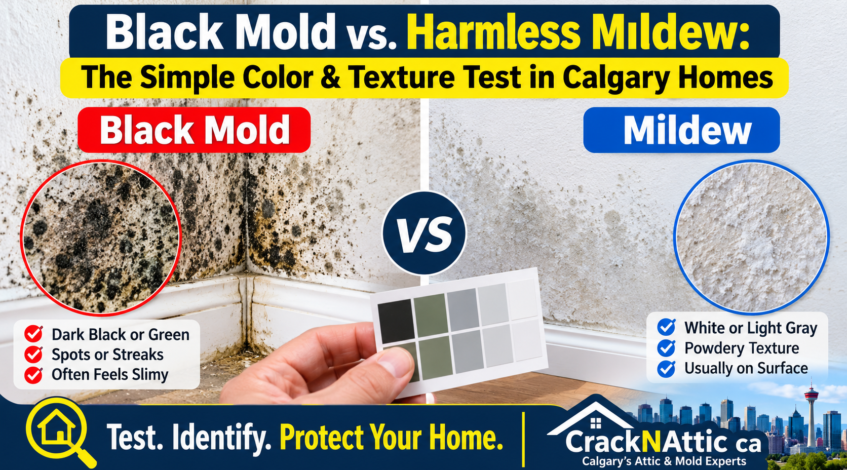
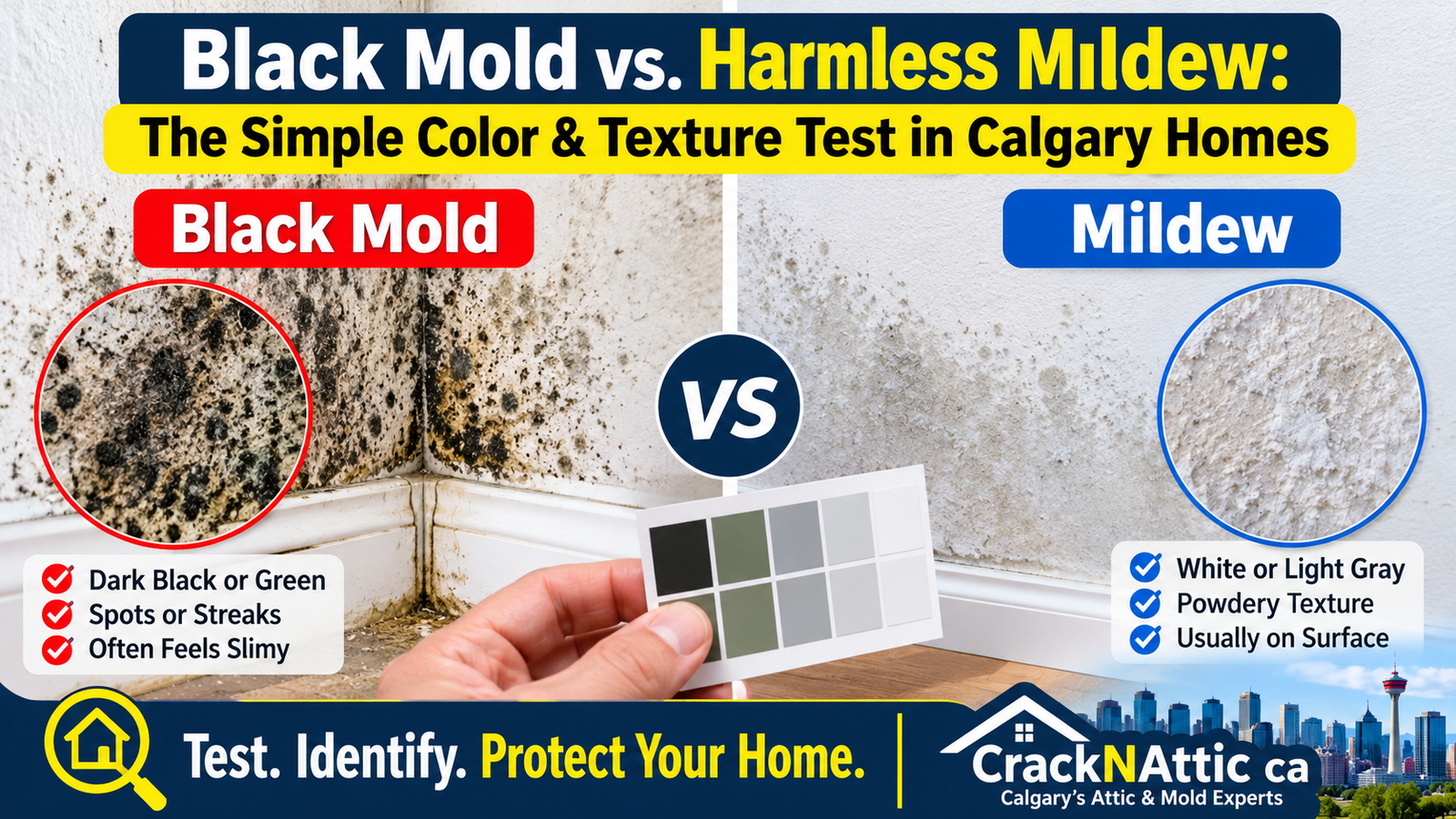
Telling the difference between surface mildew and structural mold comes down to how the growth looks, feels, and adheres to the material:
                  [Dark Discoloration Discovered]
                                 |
                 ---------------------------------
                 |                               |
       [Powdery, Flat & Light]         [Slimy/Fuzzy, Dark & Deep]
                 |                               |
          (Common Mildew)               (Active Black Mold)
                 |                               |
        Cleans off surface               Roots inside timber
The Mildew Profile
-
Color Profile: Typically light grey, dusty white, or yellow-brown. Occasionally, it appears as faint brown or pinkish speckles on painted drywall.
-
Surface Texture: Flat, dry, and powdery. It looks like someone dusted flour or powdered chalk onto the surface.
-
Growth Depth: Mildew is strictly superficial. It lives on top of non-porous or semi-porous surfaces (such as tile grout, acrylic caulk, or vinyl window sills) and does not dig roots into organic wood fibers.
-
Easy Wipe Test: A damp rag or gentle soap wash easily wipes mildew away in a single swipe, leaving the underlying material completely smooth and undamaged.
The Black Mold (Stachybotrys) Profile
-
Color Profile: Dark charcoal, jet black, or deep greenish-black. It often features dense, patchy clusters with irregular, mottled margins.
-
Surface Texture: Slimy, gelatinous, or wet when active; fuzzy, velvety, or raised like velvet when slightly dry. It rarely looks like a dry, flat powder.
-
Growth Depth: Black mold is invasive. It sends microscopic root structures—known as hyphae—deep into the cellular pores of organic substrates like OSB roof decking, plywood, dimensional lumber, and drywall gypsum paper.
-
The Scratch Test: If you wipe the surface, a dark stain remains permanently embedded inside the wood grain or drywall face. The underlying material often feels soft, spongy, or damp.
2. Mildew vs. Black Mold: Direct Diagnostic Comparison
| Characteristic | Common Surface Mildew | Toxic Structural Black Mold |
| Typical Appearance | Powdery, flat, dusting pattern | Fuzzy, slimy, raised, or clustered |
| Common Colors | White, light grey, yellowish, pink | Dark black, dark green, charcoal |
| Root Depth | Superficial; stays on the finish | Deep microscopic roots (hyphae) |
| Target Materials | Shower grout, glass frames, tubs | OSB sheathing, roof rafters, drywall, studs |
| Moisture Source | Surface condensation & daily steam | “Attic rain,” pipe bursts, foundation leaks |
| Smell Profile | Faint, sour, or stale odor | Pungent, rotten wood, earthy mushroom scent |
| Structural Danger | None (purely cosmetic) | High (causes dry rot and delamination) |
| Health Impact | Minor eye/nasal irritation | Aggravated asthma, chronic sinus infections |
3. Why Calgary Homes Are Prone to Black Mold (Not Just Mildew)
Calgary’s climate rarely creates the warm, humid outdoor conditions where mildew flourishes outside. Instead, our homes suffer from sharp internal temperature differences that generate aggressive black mold:
-
Winter “Attic Rain”: Warm living-room moisture rises naturally via the stack effect and leaks past unsealed pot lights and attic hatches. When it strikes freezing roof sheathing, it turns to frost. During a Chinook thaw, it melts in hours, drenching wood rafters in an indoor downpour that triggers black mold within 24 to 48 hours.
-
Basement Hydrostatic Infiltration: Spring runoff saturates Calgary’s dense clay soil. The expanding soil forces groundwater through foundation cold joints and settling cracks, soaking framing plates and basement drywall from behind.
-
Choked Soffit Airflow: Blocked intake eaves prevent passive ventilation, trapping warm humidity against cold roof sheathing all winter long.
4. The Dangerous DIY Mistake: Why Bleach Fails on Black Mold
When homeowners see black spots, their first instinct is usually to spray household chlorine bleach. On porous wood framing or concrete, bleach makes mold worse:
-
Surface-Only Action: The chlorine molecule is chemically too large to penetrate the microscopic pores of wood or drywall. It remains on the surface, bleaching only the top melanin color so the mold seems to vanish.
-
Water Infiltration: Household bleach is roughly 90% water. Water molecules easily soak deep into the wood grain.
-
Feeding the Roots: The mold hyphae absorb that water deep inside the lumber. Weeks later, the mold colony rebounds stronger and spreads deeper through the framing.
-
Airborne Cross-Contamination: Scrubbing mold without professional negative-air containment launches millions of microscopic spores into your central heating ducts, spreading contamination directly into upstairs bedrooms.
5. The Crack & Attic Doctor Solution: Permanent Remediation & Envelope Defense
True remediation requires mechanical extraction, hospital-grade biocides, and fixing the underlying building envelope failure.
The Crack & Attic Doctor Solution delivers an engineered, permanent cure:
-
Diagnostic Moisture Scanning: We use infrared thermal cameras and calibrated pin/pinless moisture meters to map hidden moisture paths behind drywall and across roof trusses.
-
Negative Air HEPA Containment: We seal the workspace with heavy 6-mil poly barriers and operate industrial negative-air scrubbers with medical-grade HEPA filters, ensuring zero spores escape into your living areas.
-
Mechanical Extraction: We use specialized HEPA vacuuming and abrasive wire brushing to physically strip fungal roots out of the wood grain.
-
Penetrating Antimicrobial Sealing: We apply hospital-grade, EPA-registered biocides to neutralize deep spores, followed by a durable antimicrobial coating that resists future moisture.
-
Fixing the Underlying Moisture Source:
-
In Attics: We seal ceiling air leaks with closed-cell expanding foam, clear blocked soffit eaves with rigid rafter baffles, and blow in fresh insulation to Alberta R-60 standards via our attic mold removal and insulation replacement program.
-
In Basements: We stop groundwater seepage using high-pressure polyurethane injections via our complete foundation crack repair and exterior waterproofing and commercial waterproofing service Calgary solutions.
-
✅ Unsure If It’s Mold or Mildew? Book a Professional Check!
Do not let toxic black mold quietly eat away at your roof rafters, rot your basement studs, or affect your family’s air quality. Find out exactly what is growing in your home and get a clear, permanent cure.
Contact our certified building envelope specialists today to schedule an attic and basement moisture audit, mold diagnostic check, and upfront quote!
📞 Contact Southern Alberta’s Building Envelope Specialists
-
Main Office Line: (403) 633-6616 📱
-
Direct Tech Line: (587) 830-0840 📱
-
Official Website: www.cracknattic.ca 🌐
-
Email: crackandatticdoctor@gmail.com 📧
-
Office Address: #1, Second Floor – 32 Westwinds Crescent NE, Calgary, Alberta 📍
-
Proudly Serving: Calgary, Airdrie, Chestermere, Cochrane, Okotoks, High River, and nearby Southern Alberta communities.