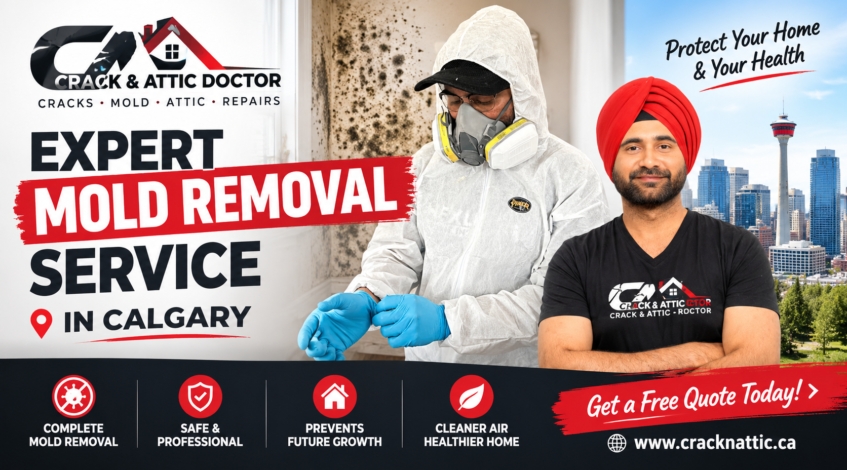
Discovering mold inside your home is alarming. Whether it appears as fuzzy black patches across attic roof sheathing, dark staining behind basement drywall, or an persistent musty odor circulating through your HVAC ducts, mold is more than a cosmetic nuisance. It is an active structural threat and a serious health hazard.
In Southern Alberta, unpredictable Chinook weather, rapid freeze-thaw cycles, and heavy clay soil create ideal conditions for indoor moisture traps. When warm, humid indoor air meets freezing structural elements, or when ground water seeps through concrete foundation walls, mold colonies colonize organic materials within 24 to 48 hours.
Spraying household bleach or applying cosmetic store-bought paints does not solve the problem—it feeds the roots and worsens the infestation.
At Crack & Attic Doctor, our certified mold removal service in Calgary delivers permanent, hospital-grade elimination. We don’t just clear visible surface stains; we track the underlying moisture source, mechanically extract fungal hyphae, purify indoor air, and seal your building envelope to ensure mold never returns.
1. Why Calgary Homes Are Uniquely Vulnerable to Mold
Mold requires three conditions to proliferate: organic food (wood framing, paper-faced drywall, ceiling joists), adequate warmth, and moisture. In Calgary, Airdrie, Cochrane, and Okotoks, our climate generates distinct moisture vulnerabilities across the home:
-
Attic Rain & Condensation: During sub-zero winters, indoor moisture rises through the home via the stack effect and leaks past unsealed pot lights, plumbing vents, and attic hatches. This moisture flash-freezes into thick rime frost on cold roof decking. When a Chinook brings rapid thaws, this frost melts in hours—drenching insulation and wood framing in an indoor downpour known as “attic rain.”
-
Basement Foundation Leaks: Calgary’s expansive clay soil swells when soaked with rain, exerting massive hydrostatic lateral pressure against concrete foundations. Water forces its way through settling cracks, tie-rod holes, and cold joints, pooling behind finished basement drywall and insulation.
-
Choked Soffit Ventilation: In roughly 70% of local homes, shifted blown-in insulation or unbaffled eaves choke off passive intake soffit vents. Without cross-ventilation, stagnant humidity stays trapped against roof decking.
-
Thermal Bridging & Poor Air Sealing: Inadequate insulation levels below Alberta’s recommended R-60 standard create interior cold spots on drywall, triggering chronic condensation and mold blooms along exterior corners and baseboards.
2. The Danger of DIY Fixes: Why Bleach Makes Mold Worse
When homeowners spot mold, their immediate reaction is often to grab a jug of household chlorine bleach. Building science shows that bleach should never be used on porous materials like wood framing, roof decking, or concrete:
-
Large Molecular Size: Chlorine molecules have high surface tension and are chemically too large to penetrate the deep microscopic pores of wood or concrete. The chlorine remains on the surface, bleaching only the melanin pigment so the mold temporarily looks gone.
-
Water Infiltration: Household bleach consists of 90% to 95% water. Water molecules are much smaller than chlorine, allowing them to penetrate deep into wood grain and concrete capillaries.
-
Feeding the Root Network: Mold roots—known as hyphae and mycelia—absorb the water that soaked into the material. Weeks later, the mold colony rebounds stronger, spreading deeper into the structural lumber.
-
Aerosolizing Toxic Spores: Scrubbing dry mold without professional negative-air containment disperses millions of microscopic spores and mycotoxins into your furnace ducts, spreading contamination directly into bedrooms and living spaces.
3. The Crack & Attic Doctor Certified Mold Remediation Process
True mold remediation requires strict containment, mechanical extraction, hospital-grade antimicrobial chemistry, and building envelope diagnostics. Our certified technicians execute a systematic, 6-stage remediation protocol aligned with IICRC S520 standards:
Step 1: Diagnostic Thermal Mapping & Moisture Detection
We inspect your property using high-resolution infrared thermal imaging cameras and calibrated moisture meters. This pinpoints hidden water pathways behind finished walls, ceiling drywall, and roof trusses without unnecessary demolition.
Step 2: Critical Containment & Negative Air Pressure
Before disturbing a single spore, we isolate the work zone (attic, basement, or crawlspace) using heavy 6-mil poly containment barriers and commercial zipper entries. Industrial negative air machines equipped with certified HEPA filters continuously pull air out of the space, ensuring zero cross-contamination into the rest of your home.
Step 3: Safe Removal of Saturated Materials
Porous items that cannot be completely decontaminated—such as mold-compromised drywall, ceiling tiles, and waterlogged, clumped fiberglass or cellulose insulation—are safely bagged inside containment, sealed, and disposed of according to hazardous waste regulations.
Step 4: Mechanical Surface Abrasion & HEPA Vacuuming
Mold embedded in structural wood trusses, OSB sheathing, or rough concrete masonry must be physically removed:
-
We vacuum all structural framing using certified HEPA vacuums that capture particulates down to 0.3 microns at 99.97% efficiency.
-
We use specialized mechanical abrasion—including intensive wire brushing, detail sanding, or media blasting—to strip fungal root networks directly out of the wood grain.
Step 5: Penetrating Antimicrobial Treatment & Encapsulation
We apply non-corrosive, commercial-grade, EPA-registered botanical and quaternary biocides deep into the wood and masonry fibers. These solutions disrupt fungal cell membranes without emitting toxic chemical vapors. Once dried, we coat structural timbers with a mold-resistant antimicrobial encapsulant that locks out future fungal colonization.
Step 6: Curing the Root Cause (Building Envelope Correction)
Remediation is only temporary if the moisture source remains active. We permanently eliminate the moisture mechanism:
-
For Attics: We execute precision air sealing on all ceiling penetrations with closed-cell expanding foam, install rigid rafter baffles along the eaves to clear choked soffits, and upgrade insulation to Alberta Building Code R-60 standards through our dedicated attic mold removal and insulation replacement program.
-
For Basements: We permanently stop groundwater seepage by injecting commercial polyurethane resin into basement fractures via high-pressure injection, backed by complete foundation crack repair and exterior waterproofing and waterproofing service Calgary solutions.
4. Attic vs. Basement Mold: How Our Treatments Differ
| Diagnostic Factor | Attic Mold Remediation | Basement Concrete Mold Remediation |
| Primary Moisture Source | Warm rising indoor air, stack effect, and Chinook attic rain | Lateral hydrostatic ground pressure and expansive clay soil |
| Typical Substrates | OSB sheathing, plywood roof deck, spruce-pine-fir trusses | Poured concrete, concrete blocks, bottom wall plates, drywall |
| Extraction Technique | HEPA vacuuming, wood fiber abrasion, containment chute | Deep HEPA extraction, masonry biocide washes, drywall cutbacks |
| Permanent Moisture Cure | Ceiling air sealing, rafter baffles, R-60 blown-in insulation | High-pressure flexible polyurethane crack injection, weeping tile check |
| Health & Living Impact | Spores migrate down via ceiling fixtures during pressure drops | Spores circulate through HVAC return air ducts across entire house |
5. When to Call a Certified Mold Remediation Specialist
Do not wait until mold covers an entire wall to take action. Contact a certified professional if you notice any of the following signs:
-
Visible Dark Staining: Black, green, or grey speckled colonies spreading across attic plywood, rafters, or basement concrete.
-
Persistent Earthy or Musty Odors: A distinct damp smell in your basement, attic, or top-floor hallways that remains even after cleaning.
-
Yellow or Brown Ceiling Rings: Water rings on upper ceilings indicating attic frost condensation melting through drywall.
-
Unexplained Respiratory Symptoms: Chronic coughing, sinus congestion, eye irritation, or aggravated asthma symptoms when spending time at home.
-
Pending Real Estate Transactions: Attic mold discovered during a buyer’s home inspection condition, requiring immediate certified clearance documentation to close the sale.
✅ Schedule Your Calgary Mold & Moisture Inspection Today!
Protect your family’s health, safeguard your building envelope, and preserve your property value with Calgary’s trusted remediation specialists. We provide transparent assessments, certified containment, and guaranteed structural cures.
Contact our certified team today to book your comprehensive mold inspection and clear quote!
📞 Contact Southern Alberta’s Building Envelope Specialists
-
Main Office Line: (403) 633-6616 📱
-
Direct Tech Line: (587) 830-0840 📱
-
Official Website: www.cracknattic.ca 🌐
-
Email: crackandatticdoctor@gmail.com 📧
-
Office Address: #1, Second Floor – 32 Westwinds Crescent NE, Calgary, Alberta 📍
-
Proudly Serving: Calgary, Airdrie, Chestermere, Cochrane, Okotoks, High River, and nearby Southern Alberta communities.