
Finding a crack in your basement wall is unsettling. Concrete naturally cures and shrinks over time, creating harmless hairline marks. However, certain crack patterns signal serious structural movement below ground.
In Calgary and Southern Alberta, our climate puts immense stress on concrete foundations. Heavy clay soil swells during rainy seasons and shrinks during dry heat. Rapid Chinook freeze-thaw cycles wedge moisture into tiny gaps.
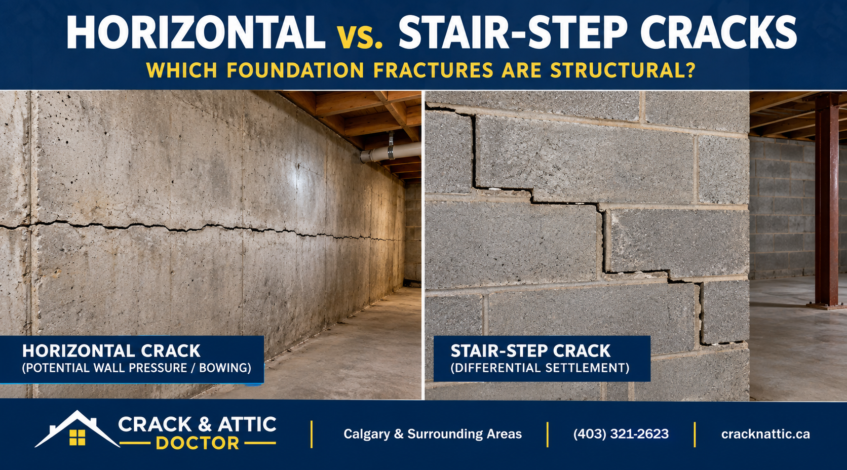
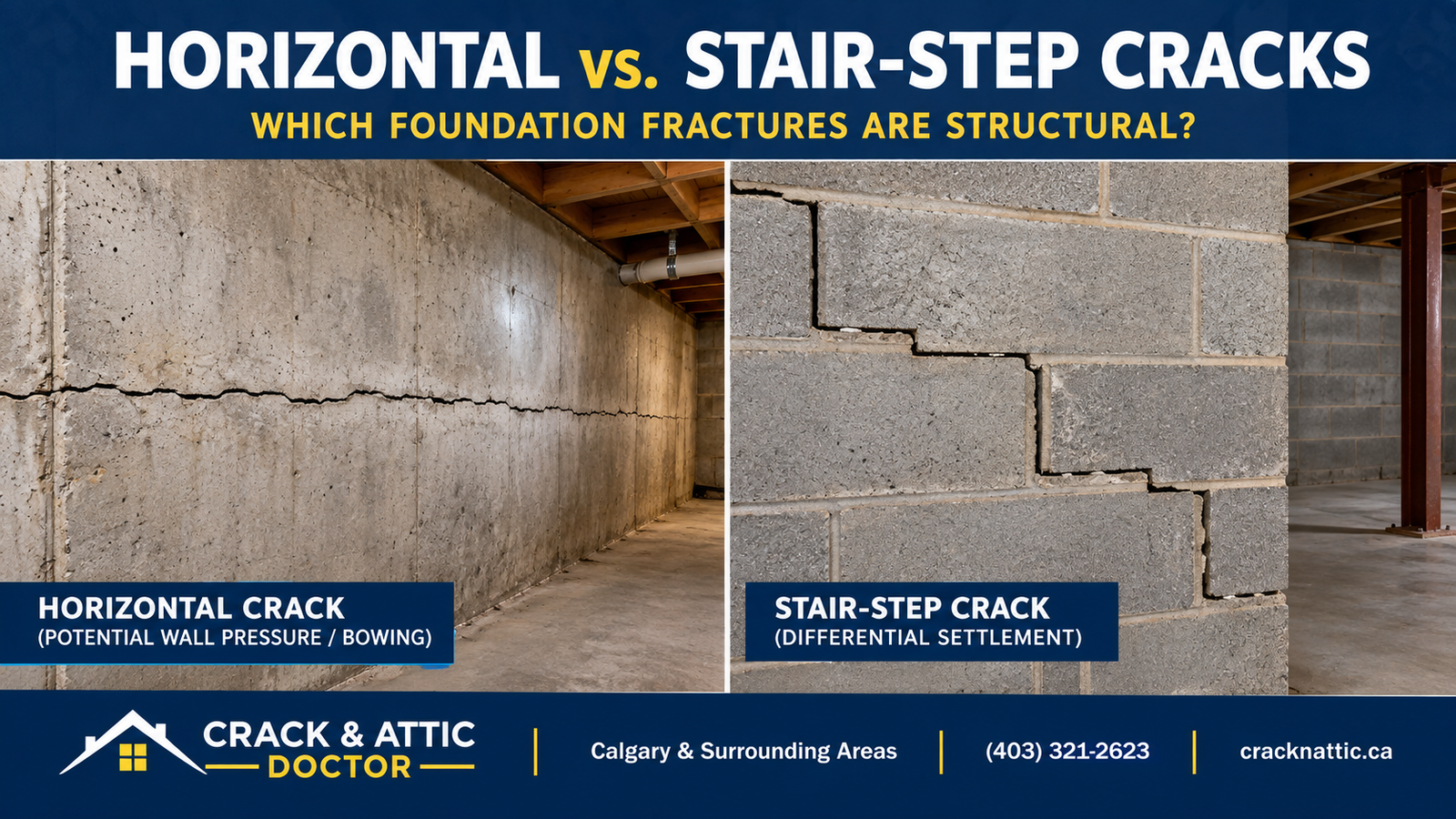
Two of the most concerning crack patterns homeowners find are horizontal cracks and stair-step cracks. Both indicate that outside forces are overpowering your concrete walls, but they stem from completely different structural failures.
Here is a clear breakdown of horizontal versus stair-step cracks, why both are serious structural threats, and how the Crack & Attic Doctor Solution restores your foundation’s integrity.
1. Horizontal Foundation Cracks: The Threat of Wall Inward Bowing
A horizontal crack runs sideways across the middle or upper section of a poured concrete or concrete block wall.
What Causes Horizontal Cracks?
Horizontal fractures are almost always caused by lateral hydrostatic pressure and expansive clay soil:
-
When heavy rain falls or spring snow melts, wet soil builds up immense weight outside your basement.
-
Alberta’s clay soil swells significantly when saturated, pushing inward against the center of the wall.
-
Because the top of the foundation is held by the house framing and the bottom is secured by the concrete footing, the middle of the wall flexes under the load.
The Structural Verdict: High Structural Emergency
-
Movement Type: Inward shear and lateral failure.
-
The Risk: Once a horizontal crack forms, the concrete wall begins to bow inward. If ignored, the structural shear strength fails completely, leading to sudden wall collapse or catastrophic water flooding.
2. Stair-Step Foundation Cracks: The Danger of Uneven Settlement
Stair-step cracks climb up concrete blocks, cinder blocks, or brick mortar joints in a diagonal zig-zag pattern. In poured concrete, they often present as sharp, diagonal 45-degree fractures starting at the corners of basement windows or wall edges.
What Causes Stair-Step Cracks?
Stair-step fractures are triggered by differential foundation settlement:
-
Foundation footings must rest on stable, compacted soil.
-
During dry summer months, clay soil dries out, shrinks, and leaves empty voids beneath sections of the footings.
-
One corner or section of the house begins to sink faster than the rest. The foundation twists, tearing open masonry joints along their weakest mortar lines.
The Structural Verdict: Critical Structural Warning
-
Movement Type: Vertical downward displacement and shifting footings.
-
The Risk: Stair-step cracks indicate that your home is sinking unevenly. Left unaddressed, framing shifts out of square, causing sticky interior doors, cracked ceiling drywall, and continuous water infiltration.
3. Comparison: Horizontal vs. Stair-Step Cracks
| Diagnostic Feature | Horizontal Cracks | Stair-Step Cracks |
| Typical Wall Type | Poured concrete & concrete block | Concrete block, cinder block, or brick |
| Primary Root Cause | Lateral hydrostatic soil pressure | Uneven footing settlement & sinking soil |
| Movement Direction | Inward bowing (middle of wall) | Vertical settlement & rotational twist |
| Associated Hazards | Structural wall collapse, inward deflection | Frame distortion, uneven floors, jammed doors |
| Water Risk | High (groundwater enters sheared joints) | Severe (water tracks along zig-zag mortar lines) |
| Urgency Level | Immediate structural stabilization | Immediate settlement assessment |
4. Are Any Basement Cracks Non-Structural?
Not all cracks threaten your home’s stability:
-
Vertical Hairline Cracks: Cracks that run straight up and down and measure less than 1/16 inch (under 1.5 mm) are typically cosmetic curing lines from when the concrete initially dried.
-
When to Worry: If a vertical crack widens to over 1/8 inch (3 mm), shows displacement (one side sticks out further than the other), or actively leaks water, it has crossed over into an active structural hazard.
5. The Crack & Attic Doctor Solution: Engineered Cures
Surface caulk, hydraulic cement, or cosmetic epoxy pastes cannot withstand moving soil. As the seasons change, surface patches snap and peel away.
The Crack & Attic Doctor Solution delivers permanent structural stability:
-
Precision Diagnostic Scanning: We evaluate crack dynamics, width, inward wall deflection, and moisture paths using non-invasive thermal sensors and diagnostic tools.
-
High-Pressure Polyurethane Injection: For leaking fractures, we drill ports at 45-degree angles and inject commercial-grade polyurethane resin under high pressure. The resin reacts with moisture, expanding up to 20 times its volume to form a tough, elastomeric seal across the entire 8- to 10-inch concrete wall.
-
Comprehensive Envelope Waterproofing: We pair structural repairs with exterior defenses like dimple drainage membranes, weeping tile diagnostics, and our full foundation crack repair and exterior waterproofing packages.
-
Whole-Home Protection: From basement structural fixes to roof-level services like attic mold removal and insulation replacement, we ensure your building envelope remains dry and safe.
✅ Book Your Free Structural Foundation Assessment Today!
Do not wait for a horizontal or stair-step crack to cause an inward wall failure or basement flood. Find out the exact mechanical cause of your foundation crack and protect your home equity.
Contact our certified team today to book your free, no-obligation structural inspection and clear quote!
📞 Contact Southern Alberta’s Building Envelope Specialists
-
Main Office Line: (403) 633-6616 📱
-
Direct Tech Line: (587) 830-0840 📱
-
Official Website: www.cracknattic.ca 🌐
-
Email: crackandatticdoctor@gmail.com 📧
-
Office Address: #1, Second Floor – 32 Westwinds Crescent NE, Calgary, Alberta 📍
-
Proudly Serving: Calgary, Airdrie, Chestermere, Cochrane, Okotoks, High River, and nearby Southern Alberta areas.
Leave a Reply