
You cleaned the mold.
A few weeks or months later, it came back.
That is frustrating. More importantly, it can be a sign that the moisture source is still there.
Mold needs moisture to grow. Health Canada recommends finding and fixing the moisture problem instead of only cleaning the visible mold.
For Calgary homeowners, moisture can enter a home in several ways.
Some sources are easy to see.
Others can stay hidden behind walls, above ceilings, inside attics, or around the foundation.
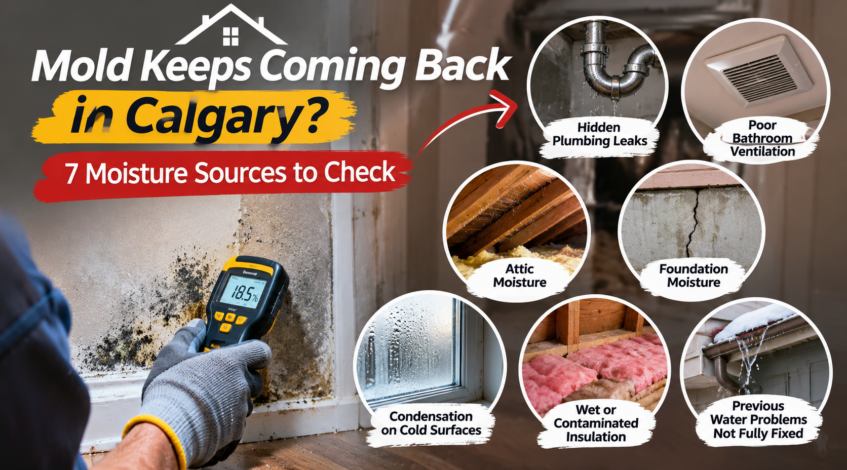
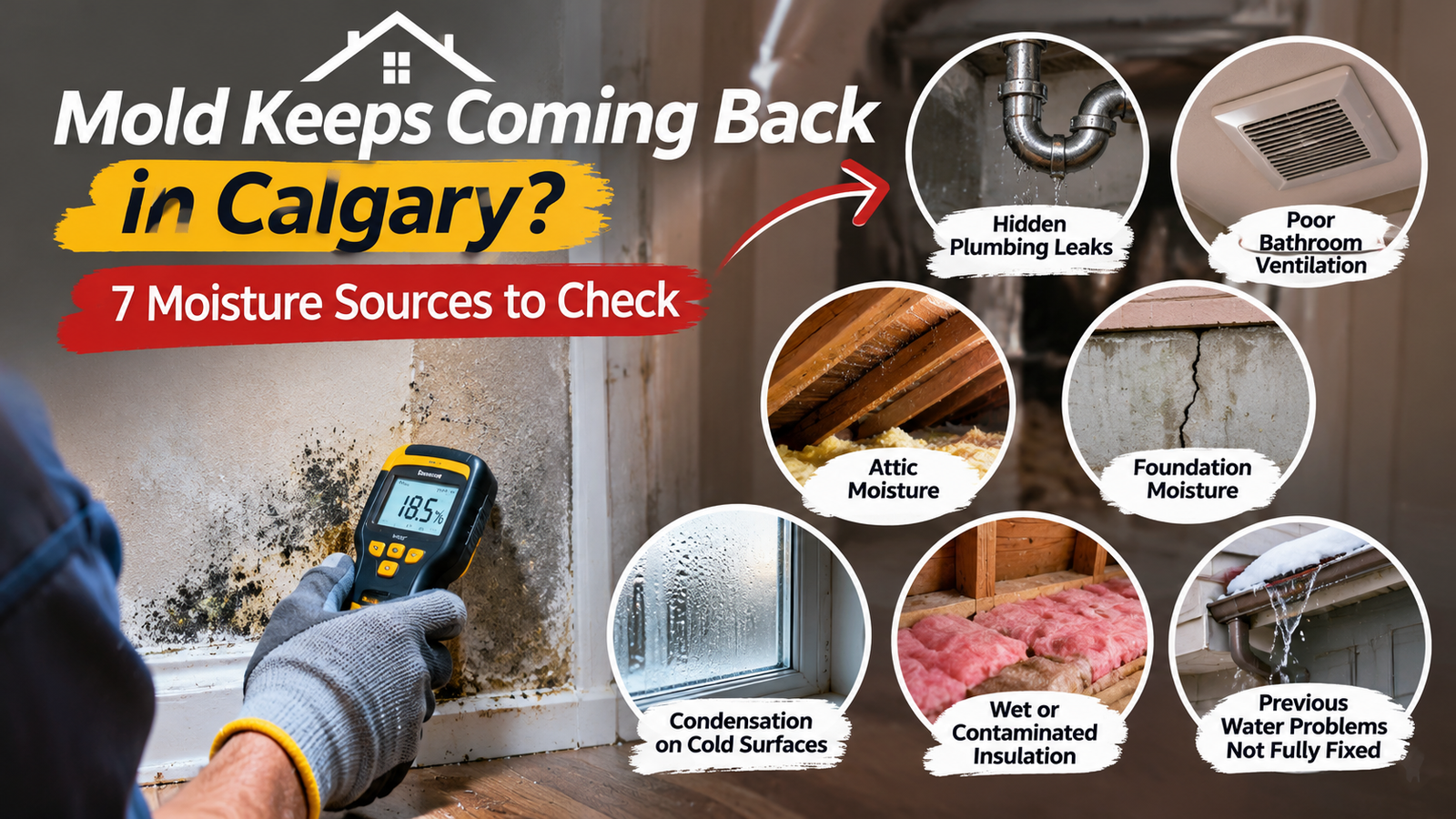
Here are seven areas worth checking when mold keeps coming back in Calgary.
1. A Hidden Plumbing Leak
A small plumbing leak can create a long-term moisture problem.
The leak may sit under a sink, behind a wall, near a washing machine, or around a bathroom fixture.
You may not see water on the floor.
Instead, you might notice:
- A musty smell
- Discoloured drywall
- Peeling paint
- Soft wood
- Swollen cabinets
- Repeated mold growth
If mold keeps returning in the same spot, check for a hidden water source.
Fixing the mold without fixing the leak will not solve the problem.
2. Poor Bathroom Ventilation
Bathrooms produce a lot of moisture.
Showers and baths add warm, humid air to the home.
That moisture needs a proper path outside.
Health Canada recommends using bathroom exhaust fans and making sure they vent outdoors. It also warns that inadequate ventilation can contribute to moisture and mold problems.
Check your bathroom fan.
Ask yourself:
- Does it actually move air?
- Does it vent outdoors?
- Is the duct connected properly?
- Does condensation remain after a shower?
- Does the bathroom stay damp for a long time?
A weak or poorly vented bathroom fan can contribute to recurring moisture problems.
3. Attic Moisture
Your attic can be another source of recurring mold.
Warm indoor air carries moisture.
If that air reaches a cold attic surface, condensation can develop.
Poor ventilation, blocked soffits, air leaks, and improperly vented exhaust fans can all contribute to attic moisture.
Health Canada specifically recommends checking attics when looking for moisture and mold problems.
Look for:
- Dark marks on roof sheathing
- Damp insulation
- Musty smells
- Rusted roofing nails
- Discoloured wood
- Signs of condensation
Do not assume every attic moisture problem is a roof leak.
The source needs to be identified first.
4. Foundation Moisture
Basement mold often starts with water entering from outside.
A foundation crack can allow moisture to enter.
Poor grading can also send water toward the foundation.
Blocked gutters and downspouts can make the problem worse.
Health Canada lists water infiltration through foundations, walls, roofs, and other openings as possible sources of indoor moisture.
Walk around your home after rain or snowmelt.
Check where water flows.
Make sure downspouts move water away from the foundation.
If the same basement area becomes damp again and again, investigate the source instead of repeatedly cleaning the mold.
5. Condensation on Cold Surfaces
Not every moisture problem comes from a leak.
Condensation can also create damp conditions.
You may notice water on:
- Windows
- Window frames
- Pipes
- Cold exterior walls
- Basement surfaces
High indoor humidity can make condensation worse.
Health Canada recommends maintaining relative humidity between 30% and 50% to help control moisture and mold.
A simple humidity meter can help you understand what is happening inside your home.
If humidity stays high, look at ventilation and moisture sources.
6. Wet or Contaminated Insulation
Insulation can hold moisture.
Once insulation becomes wet or contaminated, simply cleaning the surrounding surface may not solve the problem.
This can happen after:
- Roof leaks
- Attic condensation
- Plumbing leaks
- Flooding
- Foundation moisture
Wet materials should be assessed based on their type and condition.
If mold keeps returning around insulation, find out why the material became wet in the first place.
The source may be more important than the visible mold.
7. A Previous Water Problem Was Never Fully Fixed
Sometimes mold returns because an old problem was only partly repaired.
For example, a homeowner may:
- Clean the visible mold.
- Paint the area.
- Replace a small section of drywall.
- Leave the moisture source untouched.
The surface looks better.
The underlying problem remains.
Health Canada notes that mold can return when the source of moisture has not been addressed.
That is why recurring mold deserves investigation.
Why Mold Keeps Coming Back
The pattern is usually simple:
Moisture → Damp Material → Mold Growth → Cleaning → Moisture Remains → Mold Returns
Breaking that cycle requires more than removing the visible growth.
The moisture source must be identified and corrected.
That could mean repairing a leak.
It could mean improving ventilation.
It could mean correcting exterior drainage.
It could mean addressing attic moisture.
Each property is different.
What Should You Do If Mold Returns?
Start by looking for moisture.
Check the area where the mold appears.
Then look above, below, and around it.
Ask:
Where could the water be coming from?
Also check for musty smells in nearby rooms.
If the source is not obvious, a professional assessment can help identify moisture conditions that are difficult to see.
Health Canada recommends professional help for extensive mold, recurring mold, suspected hidden mold, or situations where the moisture source cannot be resolved.
Do Not Just Cover the Mold
Painting over a moldy surface may hide the stain.
It does not solve the moisture problem.
The same applies to repeated surface cleaning.
If the area becomes damp again, mold may return.
The better approach is to find the cause, correct the moisture problem, and then address the affected materials.
When Should You Call a Professional?
Consider professional help when:
- Mold keeps returning.
- The source of moisture is unclear.
- You suspect hidden mold.
- A large area is affected.
- There has been significant water damage.
- Your attic shows signs of moisture.
- Basement walls repeatedly become damp.
- A musty smell remains after cleaning.
A professional can help determine whether the issue is related to plumbing, ventilation, condensation, foundation moisture, attic conditions, or another source.
Final Thoughts
If mold keeps coming back in Calgary, the mold itself may not be the main problem.
Moisture is often the bigger issue.
A leak, condensation, poor ventilation, attic moisture, or foundation water can continue feeding the problem.
Cleaning the visible mold may improve the appearance.
Finding and fixing the moisture source helps address the reason it keeps returning.
If you are dealing with recurring mold, attic moisture, or basement dampness, Crack & Attic Doctor can help identify the problem and determine the right next step.
Contact Crack & Attic Doctor
Phone: (403) 321-2623
Email: crackandatticdoctor@gmail.com
Website: www.cracknattic.ca
Head Office: 715, 100, 4th Av SW, Calgary, Alberta
Branch Office: #1, Second Floor – 32 Westwinds Crescent NE, Calgary, Alberta
Serving: Calgary, Cochrane, Airdrie, Chestermere, Conrich, Okotoks, and High River