
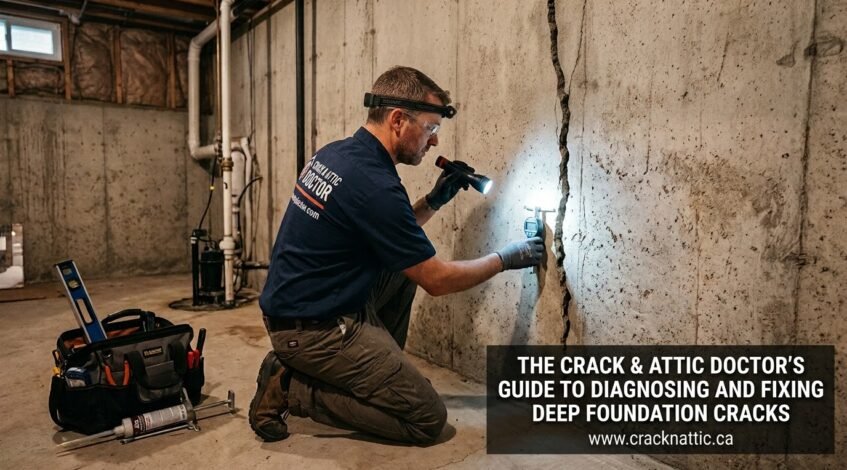
The Crack & Attic Doctor’s Guide to Diagnosing and Fixing Deep Foundation Cracks
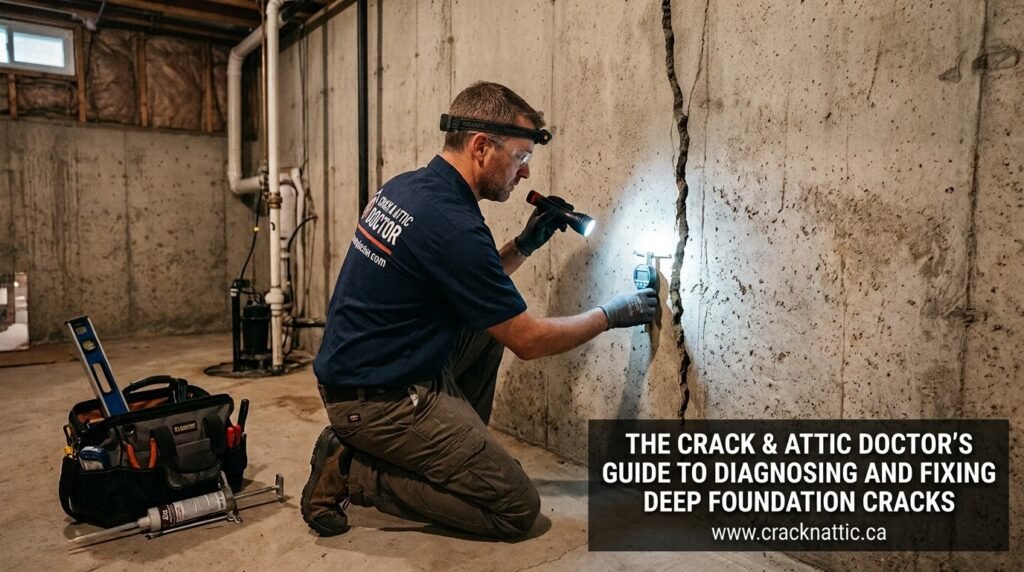
Deep foundation cracks are more than just an eyesore. They can allow water into your basement, indicate soil movement, and, in some cases, point to a larger structural problem. For homeowners in Calgary and surrounding Alberta communities, changing soil conditions, moisture, freeze-thaw cycles, and seasonal weather can place additional stress on foundation walls.
At Crack & Attic Doctor, we believe the right repair starts with the right diagnosis. A crack should never be treated simply because it is visible—the underlying cause needs to be understood first.
In this guide, we’ll explain how to identify deep foundation cracks, what causes them, when they require professional attention, and how foundation crack repair can help protect your home.
What Is a Deep Foundation Crack?
A deep foundation crack is a fracture that extends significantly into or through a concrete foundation wall rather than being limited to the surface.
Some cracks are narrow and primarily cosmetic. Others may extend through the foundation wall and create a pathway for groundwater to enter the basement.
According to the Government of Canada, foundation cracks can allow rain, snowmelt, and groundwater to enter a home, and cracks should be monitored for changes in size, direction, and moisture. (Canada)
The important question isn’t simply:
“How big is the crack?”
It’s:
“Why did the crack form, and is it changing?”
Understanding the Different Types of Foundation Cracks
The direction, location, width, and behaviour of a crack can provide important clues about its cause.
1. Vertical Foundation Cracks
Vertical cracks are relatively common in concrete foundation walls.
They can occur because of:
- Normal concrete shrinkage
- Foundation settling
- Soil movement
- Seasonal changes
- Construction-related stresses
A small, stable vertical crack may not necessarily indicate a major structural problem. However, if the crack is growing, widening, or allowing water to enter, it should be professionally evaluated.
2. Horizontal Foundation Cracks
Horizontal cracks deserve particular attention.
A horizontal crack can indicate pressure being exerted against the foundation wall by the surrounding soil. Hydrostatic pressure can increase when the soil becomes heavily saturated with rain or snowmelt.
Signs that may accompany a potentially serious horizontal foundation crack include:
- Bowing or leaning foundation walls
- Water infiltration
- Increasing crack width
- Cracks that continue to grow
- Uneven basement walls
- Doors or windows becoming difficult to operate
A horizontal foundation crack should not simply be filled with a surface patch. The condition of the wall and the forces acting on it should be assessed first.
3. Stair-Step Cracks
Stair-step cracking is particularly common in masonry or concrete block foundations.
The crack follows the mortar joints in a pattern resembling a staircase.
It may be associated with:
- Differential settlement
- Soil movement
- Lateral pressure
- Drainage problems
If stair-step cracks are expanding or accompanied by wall movement, professional assessment is recommended.
4. Cracks That Leak Water
A crack doesn’t have to be wide to cause a serious basement moisture problem.
During heavy rainfall, spring snowmelt, or periods of saturated soil, water can find its way through a foundation crack and enter the basement.
Look for:
- Damp concrete
- Water droplets
- Staining
- White mineral deposits or efflorescence
- Peeling paint
- Musty smells
- Wet basement floors
The Government of Canada recommends inspecting foundation cracks from both the inside and outside and consulting a professional when cracks are growing, extensive, or allowing water to seep through. (Canada)
Why Do Deep Foundation Cracks Happen in Calgary?
Calgary homes experience unique environmental conditions that can contribute to foundation movement and moisture problems.
Freeze-Thaw Cycles
Water expands when it freezes. Repeated freezing and thawing can contribute to movement in the soil surrounding a foundation.
Soil Movement
Changes in soil moisture can cause soil to expand, contract, or shift. This movement can place pressure on foundation walls.
Hydrostatic Pressure
When water accumulates in the soil around a basement, it can create pressure against foundation walls.
Poor Drainage
Blocked or poorly functioning drainage systems, improper grading, or downspouts directing water toward the foundation can increase moisture around the home.
Foundation Settlement
Homes naturally settle, but uneven settlement can create stress and cracking.
Crack & Attic Doctor’s Calgary-focused guidance highlights freeze-thaw conditions, clay-heavy soils, drainage, moisture, and settlement as factors homeowners should consider when diagnosing basement cracks. (Crack & Attic Doctor)
How to Diagnose a Deep Foundation Crack
A professional diagnosis should look beyond the visible crack.
Step 1: Examine the Crack
Measure and document:
- Crack width
- Crack length
- Direction
- Location
- Whether it extends through the wall
- Whether it appears to be growing
Take photographs so changes can be compared over time.
Step 2: Look for Water
Determine whether the crack is:
- Completely dry
- Damp
- Leaking occasionally
- Actively leaking
A crack that leaks only after heavy rain or snowmelt can still represent a significant waterproofing problem.
Step 3: Inspect the Outside
The exterior of the foundation can reveal important clues.
Check:
- Soil grading
- Downspouts
- Gutters
- Standing water
- Landscaping near the foundation
- Visible exterior cracks
- Drainage conditions
A foundation repair can be much more effective when the source of water or movement is addressed rather than simply treating the visible symptom.
Step 4: Check for Structural Movement
Look for signs such as:
- Bowing walls
- Horizontal cracking
- Uneven floors
- Doors or windows sticking
- Multiple interconnected cracks
- Cracks appearing in several areas
These symptoms may indicate that the problem goes beyond simple waterproofing.
When Should You Call a Foundation Repair Professional?
You should consider professional assessment when a foundation crack:
- Is growing or changing
- Is wider than approximately 5 mm
- Allows water into the basement
- Is horizontal
- Forms a large network of cracks
- Is accompanied by wall movement
- Appears alongside significant settlement
- Continues to return after previous repairs
Canadian government guidance specifically recommends professional evaluation for cracks that are growing, extensive, or allowing water to seep into the home. (Canada)
Don’t wait for a small problem to become a major basement repair.
How Are Deep Foundation Cracks Repaired?
There isn’t one repair method that works for every crack.
The correct solution depends on the crack’s cause, location, size, movement, water exposure, and the condition of the surrounding foundation.
Polyurethane Injection
Flexible polyurethane injection can be used for certain leaking foundation cracks.
The material expands into the crack and helps create a flexible seal designed to accommodate some movement.
This can be particularly useful where the primary objective is stopping water infiltration.
Crack & Attic Doctor uses high-pressure polyurethane injection as part of its foundation crack repair approach. (Crack & Attic Doctor)
Epoxy Injection
Epoxy injection can be appropriate for certain stable cracks where structural bonding is required.
However, epoxy is rigid. Therefore, it may not be the appropriate solution for every foundation crack, particularly where continued movement is expected.
A professional should determine which material and repair system is appropriate.
Exterior Waterproofing
In some situations, repairing the crack from the outside may be necessary.
Exterior waterproofing can involve addressing the foundation wall, drainage, waterproofing layers, and surrounding soil conditions.
This approach may be recommended when water pressure or external moisture is contributing significantly to the problem.
Drainage Improvements
Sometimes the crack isn’t the only problem.
Your foundation may also require improvements such as:
- Better grading
- Downspout extensions
- Drainage repairs
- Weeping-tile or perimeter-drain solutions
- Sump-pump improvements
- Exterior waterproofing
Canada’s foundation-maintenance guidance also recommends maintaining grading, downspouts, drainage systems, sump pumps, and related measures to reduce foundation water problems. (Canada)
Why DIY Foundation Crack Repair Can Be Risky
A tube of caulking or a DIY crack-repair kit may make a crack look better—but appearance isn’t the same as solving the problem.
If the crack is caused by:
- Soil movement
- Hydrostatic pressure
- Foundation settlement
- Structural movement
- Exterior drainage problems
then sealing the visible surface may not address the underlying cause.
The result can be a recurring crack, continued water infiltration, or a more expensive repair later.
A foundation crack should be diagnosed before it is repaired.
The Crack & Attic Doctor Approach
At Crack & Attic Doctor, our philosophy is simple:
Diagnose → Plan → Repair → Protect
We begin by understanding the condition of the crack and the surrounding foundation.
Then we determine the appropriate repair strategy rather than applying the same solution to every situation.
Our services include:
- Foundation crack repair
- Basement crack repair
- Foundation waterproofing
- Basement waterproofing
- Concrete crack injection
- Leak prevention and repair
- Exterior waterproofing
- Home moisture solutions
Our website describes a four-step process: inspect the property, develop a customized solution, complete the repair, and provide follow-up support. (Crack & Attic Doctor)
Don’t Ignore a Deep Foundation Crack
A foundation crack doesn’t automatically mean your house is unsafe.
But it does mean your home is telling you something.
The sooner you understand the cause, the easier it can be to choose the appropriate repair and prevent moisture or structural problems from becoming more complicated.
If you’ve discovered a deep, growing, leaking, or horizontal foundation crack, don’t cover it up and hope it disappears.
Get it diagnosed. Understand the cause. Fix the problem properly.
Foundation Crack Repair in Calgary & Surrounding Areas
Crack & Attic Doctor provides foundation and waterproofing solutions for homeowners throughout Calgary and surrounding communities, including:
Calgary • Airdrie • Cochrane • Chestermere • Conrich • Okotoks • High River
If you’re concerned about a foundation crack, contact Crack & Attic Doctor for an assessment and discuss the right repair solution for your home.
Crack & Attic Doctor
Your Professional Doctor for Cracks & Attic
📞 (403) 321-2623
📧 crackandatticdoctor@gmail.com
🌐 www.cracknattic.ca
Frequently Asked Questions About Deep Foundation Cracks
Are deep foundation cracks dangerous?
Not every deep crack represents a structural emergency. However, cracks that are growing, horizontal, leaking, accompanied by wall movement, or part of a larger cracking pattern should be professionally evaluated.
Can a foundation crack cause a basement leak?
Yes. A crack can provide a pathway for groundwater to enter the basement, particularly when surrounding soil becomes saturated.
Should I repair a foundation crack from inside or outside?
It depends on the cause and condition of the crack. Some cracks can be treated from the interior, while others may require exterior waterproofing or drainage work.
Is polyurethane better than epoxy for foundation cracks?
Neither material is universally “better.” Polyurethane is flexible and commonly used for sealing certain leaking cracks, while epoxy can be useful for appropriate stable cracks where structural bonding is needed. The correct choice depends on the specific crack.
How often should I inspect my foundation?
At minimum, inspect your foundation annually and pay particular attention after major rainfall, snowmelt, or significant seasonal changes. Canada’s guidance recommends checking for foundation cracks at least once a year. (Canada)
Can a small foundation crack become a bigger problem?
It can. A crack may remain stable, but changes in moisture, soil conditions, or foundation movement can cause it to expand or begin leaking. Monitoring and early professional assessment can help identify changes before the problem becomes more expensive.
Final Word from the Crack & Attic Doctor
Your foundation is the structural base of your home. Don’t ignore the warning signs.
Whether you have a hairline crack, a leaking basement wall, or a deep foundation crack, the right first step is understanding what caused it.
At Crack & Attic Doctor, we don’t believe in simply hiding cracks.
We diagnose the problem. We identify the cause. We recommend the right repair.
Your home deserves more than a temporary patch—it deserves the right cure.
Leave a Reply