
See frost in your attic? Do not ignore it.
A cold Calgary night can turn hidden moisture into frost on your attic roof deck.
Then the weather changes.
A Chinook arrives. Temperatures rise. That frozen moisture starts to melt.
Suddenly, homeowners may notice wet insulation, ceiling stains, dripping water, or a musty smell.
Many people think the roof is leaking.
Sometimes it is not.
The problem may have started inside the home.
Warm, moist indoor air can escape into a cold attic. When that moisture reaches cold roof surfaces, it can condense or freeze. Government of Canada guidance recommends checking an attic during or just after a cold snap for condensation and heavy frost.
That makes attic frost in Calgary a warning sign worth taking seriously.
Here are seven things to check before the next Chinook.
1. Heavy Frost on the Roof Deck
A small amount of frost can occur during very cold weather.
Heavy frost is different.
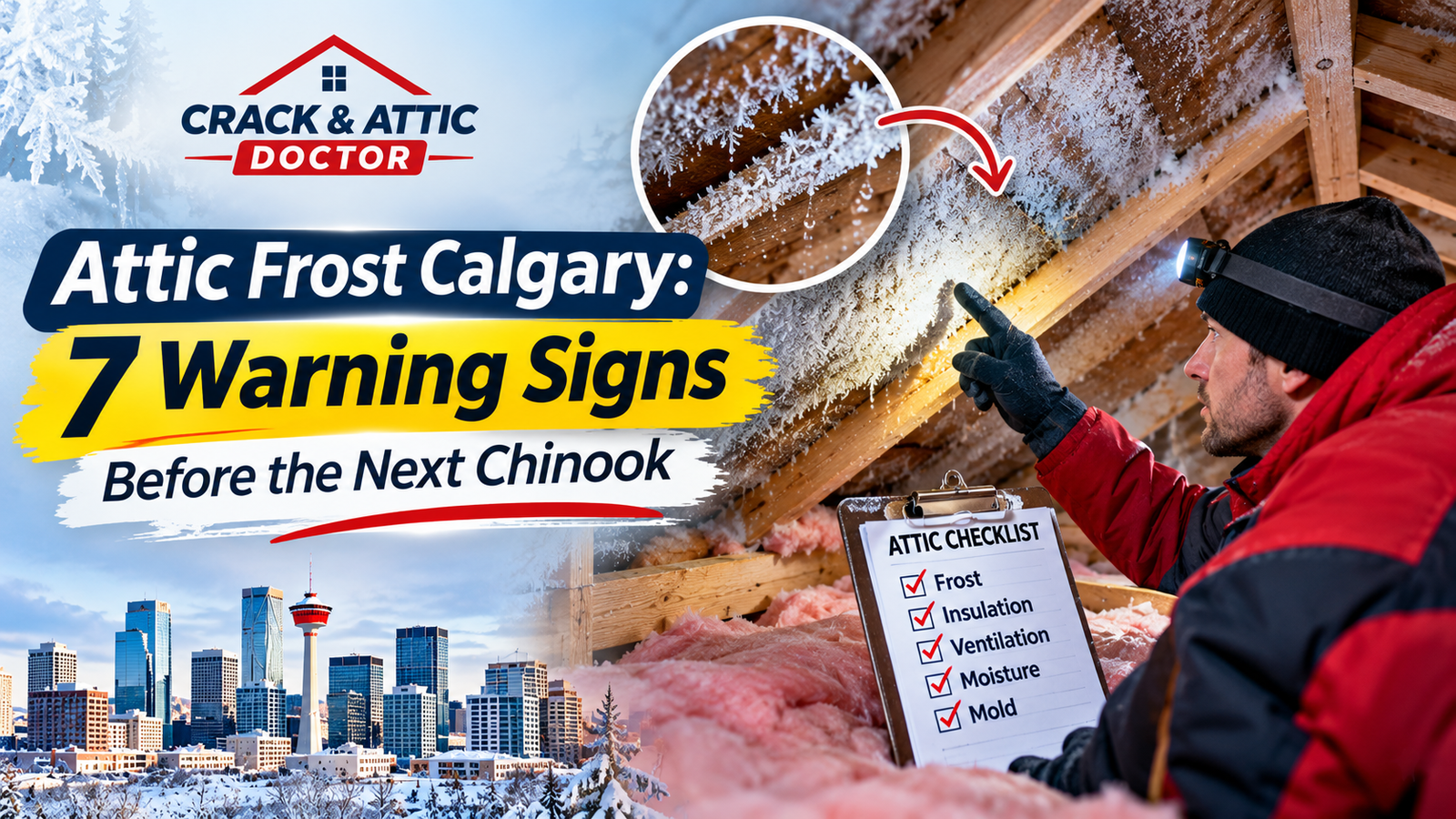
Look at the underside of the roof deck if you can safely access the attic.
Watch for:
- Thick white frost
- Frost covering large areas
- Frost around nails
- Frost near attic penetrations
- Frost that keeps returning
Heavy frost means moisture is reaching cold surfaces.
The next warm spell may turn that frost into water.
2. Wet or Compressed Insulation
Check your attic insulation.
It should not be wet.
Look for:
- Damp patches
- Dark areas
- Compressed insulation
- Ice or frost around insulation
- Water stains
- Areas that look different from the rest of the attic
Wet insulation can point to a moisture problem.
The source could be condensation.
It could also be a roof leak or another water-entry issue.
Do not simply cover wet insulation with new insulation.
Find the source first.
3. Rusty Nails or Dark Roof Sheathing
Small details can reveal a bigger problem.
Look at exposed nails and roof sheathing.
Rusty nails can appear where moisture has repeatedly reached cold metal.
Dark staining on roof wood can also deserve attention.
These signs do not prove that you have mold or a roof leak.
They do tell you that the attic may have experienced moisture.
An inspection can help identify where that moisture is coming from.
4. Blocked Soffit Vents
Your attic needs a clear airflow path.
Soffit vents help bring outside air into the attic.
If insulation blocks the soffit openings, airflow can become restricted.
That can allow moisture to remain in the attic.
Check the edges of the attic for insulation that has moved into the ventilation path.
Also look for missing or damaged ventilation channels.
A professional can determine whether the attic has enough intake and exhaust airflow for the roof design.
5. Frost Around Bathroom Fans or Attic Penetrations
Bathroom showers create moisture.
That moisture needs to leave the home.
If warm, humid air escapes into the attic instead, it can create condensation and frost.
Pay special attention to areas around:
- Bathroom exhaust ducts
- Plumbing penetrations
- Attic hatches
- Electrical openings
- Pot lights
- Chimney areas
The Government of Canada identifies ceiling penetrations, bathroom and kitchen vents, plumbing stacks, and other openings as common places where warm indoor moisture can enter an attic.
6. A Musty Smell Upstairs
Do not ignore a new musty smell.
It can be difficult to locate the source from inside the living area.
The smell may come from:
- Attic moisture
- Damp insulation
- Mold growth
- Hidden water damage
- Poor ventilation
A musty smell does not prove that mold is present.
However, if the smell keeps returning, it deserves investigation.
Especially if you also see frost, water stains, or damp insulation.
7. Water After a Warm-Up
This is one of the biggest warning signs.
You experience a cold spell.
Then the temperature rises.
Suddenly you see:
- Ceiling stains
- Drips
- Wet insulation
- Damp attic wood
- Water around an attic hatch
- Moisture near light fixtures
The timing matters.
If water appears after a cold period and warm-up, attic frost and condensation may be part of the problem.
Do not automatically assume that the roof has failed.
Find the source first.
Why the Next Chinook Matters
Calgary weather can change quickly.
A cold period can be followed by a major temperature increase.
That change can expose attic moisture problems that were hidden while everything was frozen.
Frost that looked harmless can melt.
Water can move into insulation.
Moisture can reach ceilings.
Repeated moisture can create conditions for mold and material damage.
That is why the best time to investigate attic frost is before the problem becomes visible inside your home.
Attic Frost vs. Roof Leak: What Is the Difference?
The two problems can look similar.
A roof leak often becomes noticeable after rain or snowmelt.
Attic condensation can become noticeable after cold weather followed by a warm-up.
The location can also provide clues.
A roof leak may be concentrated near a roof penetration, flashing problem, valley, or damaged roofing area.
Condensation can affect broader areas of the attic.
Still, homeowners should avoid guessing.
Both problems can cause water damage.
A professional inspection can help determine the actual source.
Why Attic Frost Can Become Attic Rain
The process can be simple:
Warm indoor air → attic moisture → cold roof surface → frost → temperature rises → frost melts → water
That is why attic frost should not be treated as a harmless winter decoration.
If the same moisture cycle happens repeatedly, insulation and roof materials may stay damp.
That can create bigger problems over time.
Crack & Attic Doctor has already identified attic rain, ventilation, air sealing, and mold as connected issues in its Calgary attic work.
What Causes Attic Frost?
Several conditions can contribute.
Poor Air Sealing
Warm indoor air can escape through gaps around ceiling penetrations.
High Indoor Humidity
Showers, cooking, laundry, and other daily activities add moisture to indoor air.
Blocked Soffit Vents
Blocked intake airflow can reduce attic ventilation.
Poor Exhaust Venting
Bathroom or kitchen exhaust should not dump warm, moist air into the attic.
Insulation Problems
Missing, uneven, or poorly installed insulation can create cold areas where condensation becomes more likely.
Roof or Flashing Problems
Not every moisture problem comes from inside.
Exterior water entry can also affect the attic.
The important point is simple:
Find the source before choosing the repair.
Should You Add More Insulation?
Not necessarily.
More insulation may help when the attic has insufficient insulation.
But insulation alone will not fix an active moisture source.
If warm air is leaking into the attic, air sealing may be needed.
If airflow is restricted, ventilation may need attention.
If a bathroom fan vents into the attic, that problem must be corrected.
If the roof is leaking, the exterior source needs repair.
Adding insulation without finding the cause can hide the problem.
What Should Calgary Homeowners Do Today?
If you suspect attic frost, start with a simple check.
Look for:
- Heavy frost
- Wet insulation
- Dark roof sheathing
- Rusty nails
- Blocked soffit vents
- Water stains
- Musty smells
- Moisture around attic penetrations
Do not disturb suspected asbestos-containing insulation.
Do not walk on areas of the attic that are not designed to support your weight.
If you cannot safely inspect the area, call a professional.
When Should You Call Crack & Attic Doctor?
Do not wait for water to appear on your ceiling.
Professional help makes sense when you notice:
- Heavy attic frost
- Recurring condensation
- Wet insulation
- Mold or suspected mold
- Water stains
- Musty attic smells
- Repeated attic moisture
- Blocked ventilation
- Water appearing after a cold snap
- Unexplained ceiling damage
The goal is not simply to remove the visible moisture.
The goal is to find out why it is happening.
The Bottom Line
Attic frost is a warning sign.
It may be harmless in a very small amount.
Heavy or repeated frost deserves attention.
The next Chinook can turn frozen moisture into water.
That water can damage insulation, ceilings, and attic materials.
It can also create conditions that support mold growth.
So if you see frost in your Calgary attic this winter, do not wait until the ceiling starts dripping.
Find the source early.
Fix the moisture problem.
Protect your home before a small winter warning becomes a larger repair.
Contact Crack & Attic Doctor
Phone: (403) 321-2623
Email: crackandatticdoctor@gmail.com
Website: www.cracknattic.ca
Head Office: 715, 100, 4th Av SW, Calgary, Alberta
Branch Office: Second Floor – 32 Westwinds Crescent NE, Calgary, Alberta
Serving: Calgary, Cochrane, Airdrie, Chestermere, Conrich, Okotoks, and High River
FAQ
Is attic frost normal in Calgary?
A small amount of frost can occur during very cold weather. Heavy or repeated frost can point to excessive moisture, air leakage, or ventilation problems and should be investigated. Canada
Why does my attic get frost?
Warm, moist indoor air can escape through gaps in the ceiling and reach cold attic surfaces. That moisture can condense or freeze as frost.
Can attic frost cause mold?
Repeated moisture can create damp conditions that support mold growth. The moisture source should be addressed rather than only cleaning visible mold.
Is attic frost the same as a roof leak?
No. Attic frost can result from indoor moisture and condensation. Roof leaks are caused by exterior water entry. The two can look similar, so identifying the source matters.
What happens when attic frost melts?
Melted frost can wet insulation and attic materials. In some homes, it can contribute to ceiling stains or dripping water during a warm-up.
Should I inspect my attic after a cold snap?
Yes. Government of Canada guidance recommends checking attics during or just after a cold snap for condensation and frost. Canada
Seeing frost in your attic? Don’t wait for the next Chinook to turn it into water.
Contact Crack & Attic Doctor for professional attic, mold, moisture, and repair services.
(403) 321-2623
crackandatticdoctor@gmail.com
www.cracknattic.caServing Calgary and surrounding Southern Alberta communities.
IMPORTANT LINKS
These existing pages fit naturally with this article: