
If you’re a Calgary homeowner, you know the drill. A brutal week of -30°C is suddenly interrupted by a warm, welcoming Chinook. But while you’re enjoying the break from the cold, your attic might be experiencing a disaster known as “Attic Rain.”
Water dripping from pot lights, damp spots on the ceiling, or even ice forming on your attic hatch aren’t always signs of a roof leak. More often than not, they are the result of a “broken” relationship between your insulation and your ventilation.
At Crack & Attic Doctor, we specialize in diagnosing and curing this exact problem. Here is how these two systems work together to keep your home dry and safe.
What is Attic Rain?
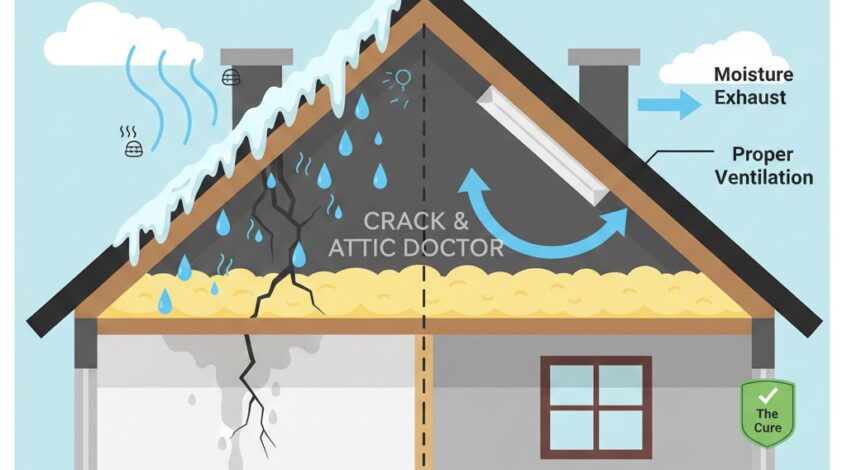
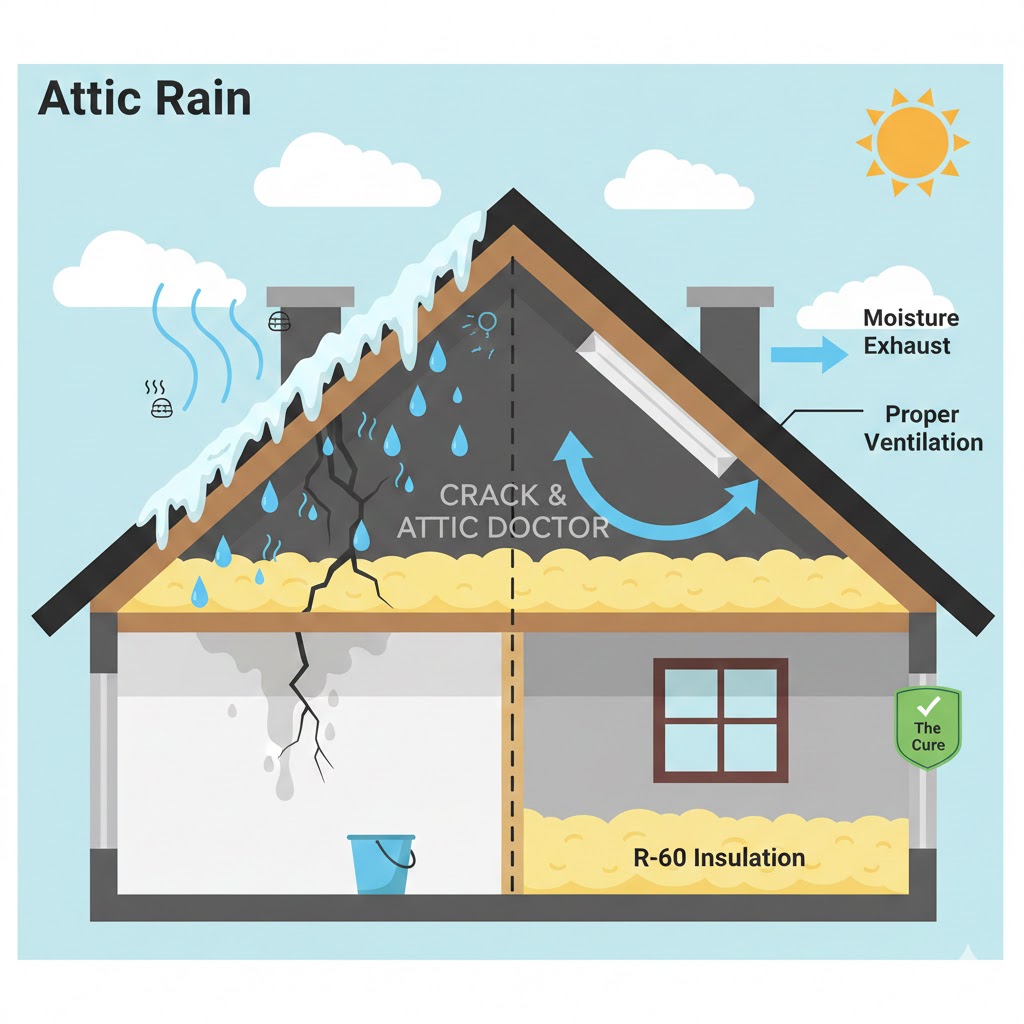
Attic rain occurs when warm, moist air from your living space escapes into the cold attic. In Calgary’s extreme winters, this moisture freezes instantly on the underside of your roof sheathing, creating a thick layer of frost.
When the temperature rises (hello, Chinook!), that frost melts all at once. Since the water has nowhere to go, it “rains” down into your insulation and through your drywall.
The Symbiotic Relationship: Insulation vs. Ventilation
Think of your attic like a lung. For it to function, it needs to breathe (ventilation) while keeping the body heat where it belongs (insulation). If one fails, the system collapses.
1. Insulation: The Barrier
Insulation’s job is to keep heat inside your home. However, it’s not just about “thickness.”
-
The Vapor Barrier: This is the plastic layer beneath your insulation. If it is torn or unsealed around pipes and wires, warm air leaks into the attic.
-
The R-Value: Proper insulation depth (aiming for R-52 or R-60 in Alberta) ensures the attic stays cold. If your insulation is too thin, your ceiling acts like a heater, melting snow on the roof and contributing to frost buildup.
2. Ventilation: The Airflow
Even with great insulation, some moisture will always find its way up. Ventilation is the “exhaust system” that carries that moisture out before it can freeze.
-
Intake (Soffits): Fresh, cold air enters through the eaves.
-
Exhaust (Roof Vents): Warm, moist air is pushed out the top.
-
The Problem: Many homes have “blocked” soffits because insulation was blown in too tightly against the roof edge. Without baffles (vent chutes) to keep that pathway open, your attic becomes a stagnant, humid box.
The “Doctor’s” 3-Step Cure
At Crack & Attic Doctor, we don’t just add more insulation; we fix the system.
-
Air Sealing: We find the “bypass” points—pot lights, plumbing stacks, and attic hatches—where warm air is escaping and seal them tight.
-
Baffle Installation: We ensure your soffit vents are clear so that fresh air can actually enter the attic space.
-
Proper Exhaust: We verify that your bathroom fans are venting directly outside—not into the attic—and that you have enough roof vents to handle the square footage of your home.
Don’t Wait for the Melt
Attic rain leads to more than just ceiling stains; it’s the primary cause of mold growth and structural wood rot. If you noticed frost in your attic during the last cold snap, the time to act is now—before the next thaw.
Contact the Experts Today
Protect your home from the inside out. Crack & Attic Doctor provides expert attic inspections and permanent solutions for attic rain across Calgary and the surrounding areas.
-
Phone: (403) 321-2623
-
Email: crackandatticdoctor@gmail.com
-
Calgary Offices: * 715, 100, 4th Av SW, Calgary, AB
-
#1, 32 Westwinds Crescent NE, Calgary, AB
-
-
Website: www.cracknattic.ca
Serving: Calgary, Cochrane, Airdrie, Chestermere, Conrich, Okotoks, and High River.
Leave a Reply