
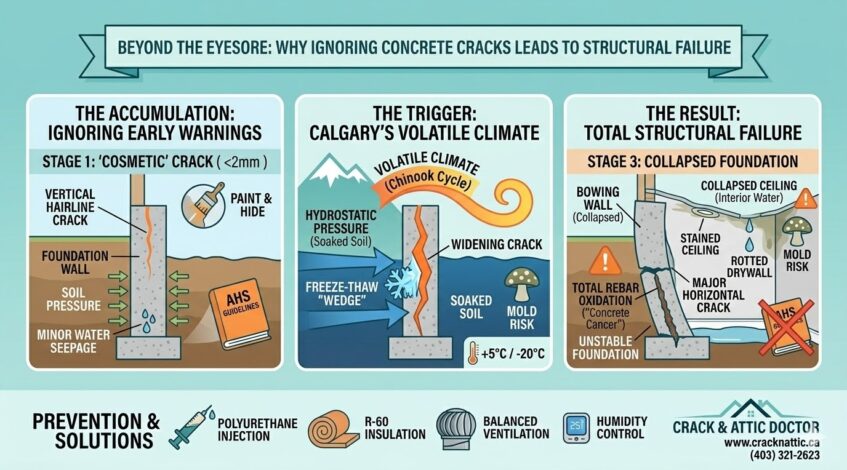
To the untrained eye, a thin crack in a basement floor or a hairline fracture in a foundation wall looks like a minor cosmetic nuisance. You might think, “I’ll just paint over it” or “It’s been there for years; it’s fine.”
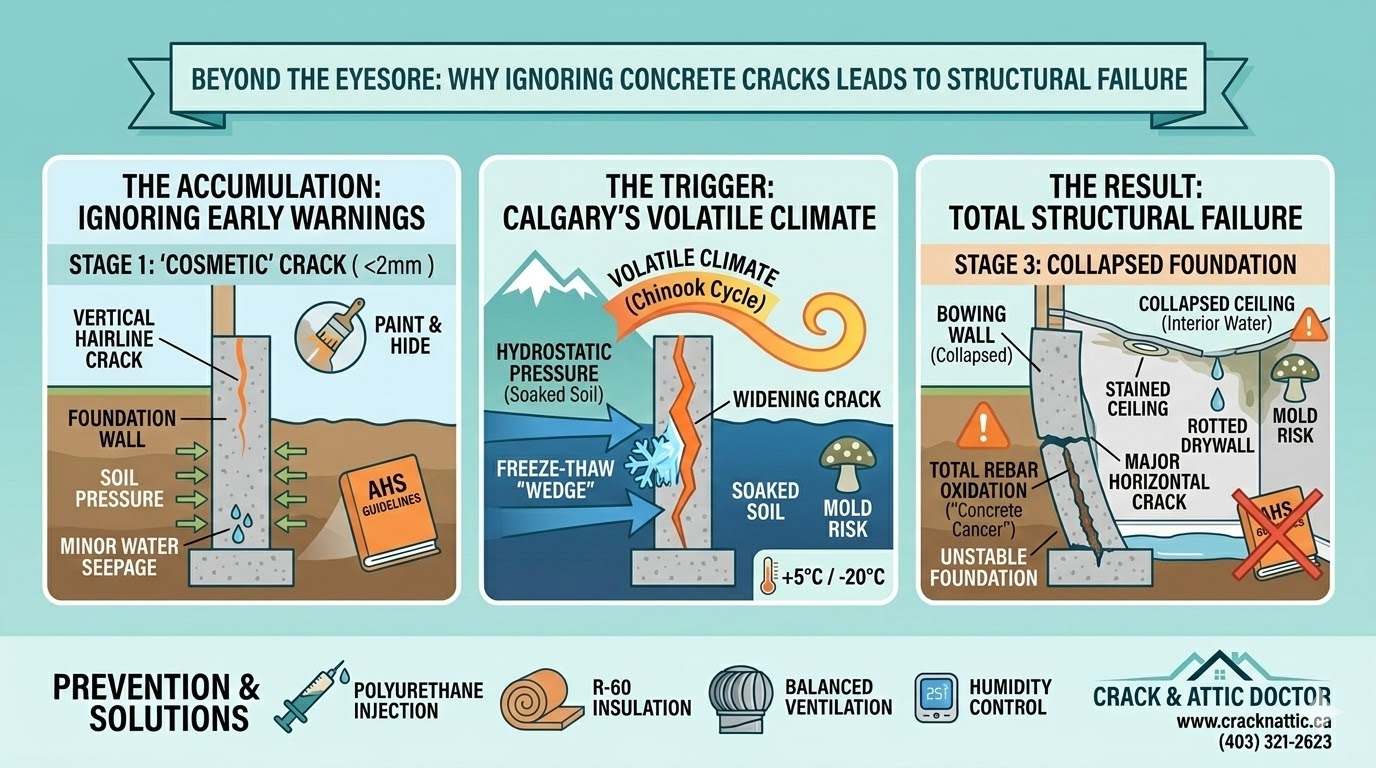
But in Calgary’s volatile climate, concrete cracks are rarely “just” cosmetic. In 2026, structural engineering has proven that ignoring these early warning signs is the fastest way to turn a $500 repair into a $50,000 structural failure.
At Crack & Attic Doctor, we don’t just “fill” cracks—we stop the cycle of decay. Here is the science of why those cracks are a ticking time bomb for your home.
The Anatomy of a Concrete Crack 🧐🧪
Concrete is incredibly strong under compression (pushing), but it is naturally weak under tension (pulling). When the soil around your Calgary home shifts due to our famous freeze-thaw cycles, the concrete is forced to bend. Since it can’t bend, it snaps.
Once a crack exists, the “Cycle of Degradation” begins:
1. Water Infiltration & Hydrostatic Pressure 💧🌊
Water is a solvent. When it finds a crack, it enters and begins to slowly dissolve the lime and calcium that hold your concrete together. As more water enters, the pressure from the wet soil outside (hydrostatic pressure) pushes against the weakened wall, causing the crack to widen.
2. The Freeze-Thaw “Wedge” ❄️🔨
In Calgary, water inside a crack will freeze. When water turns to ice, it expands by roughly 9%. This acts like a hydraulic wedge, driving deeper into the concrete and forcing the crack open further every single winter.
3. Rebar Oxidation (The “Cancer” of Concrete) 🦀🏗️
Most foundation walls contain steel reinforcement (rebar). Once a crack reaches the steel, oxygen and water cause the metal to rust. Rusting steel expands up to 4 times its original size. This internal expansion causes the concrete to “spall” or flake off, leading to total structural instability.
3 Signs Your Crack is a Structural Emergency 🚨🆘
Not every crack requires a full foundation overhaul, but these three signs mean you need to call the “Doctor” immediately:
-
Horizontal Cracks: Unlike vertical cracks (often caused by settling), horizontal cracks usually indicate lateral soil pressure. This means your wall is literally bowing inward and could eventually collapse.
-
Stair-Step Cracks: If you see cracks following the mortar lines in a “stair-step” pattern in your basement blocks, your foundation is shifting unevenly.
-
The “Penny Test”: If a crack is wider than the thickness of a penny (approx. 1.5mm), it is no longer “hairline.” It is now a highway for water and radon gas.
The 2026 Solution: High-Pressure Polyurethane Injection 💉🛡️
In the past, people used hydraulic cement to patch cracks. This fails because cement is rigid—when the house moves again, the patch pops out.
In 2026, we use High-Pressure Polyurethane Injection.
-
Flexibility: The resin remains slightly flexible, moving with your home during Chinooks.
-
Expansion: It expands to fill the entire void, from the inside of your basement all the way to the outside dirt.
-
Hydrophobic: It creates a permanent, waterproof seal that even high-pressure groundwater cannot penetrate.
Protect Your Investment 📞🚑
Your foundation is the most important part of your home. Don’t let a “small” crack compromise your largest asset.
-
Phone: (403) 321-2623 📱
-
Email: crackandatticdoctor@gmail.com 📧
-
Website: www.cracknattic.ca 🌐
-
Locations: 📍 715, 100, 4th Av SW, Calgary | 📍 #1, 32 Westwinds Crescent NE, Calgary
Serving: Calgary, Airdrie, Cochrane, Chestermere, Okotoks, and surrounding areas. 🏙️🗺️
Leave a Reply