
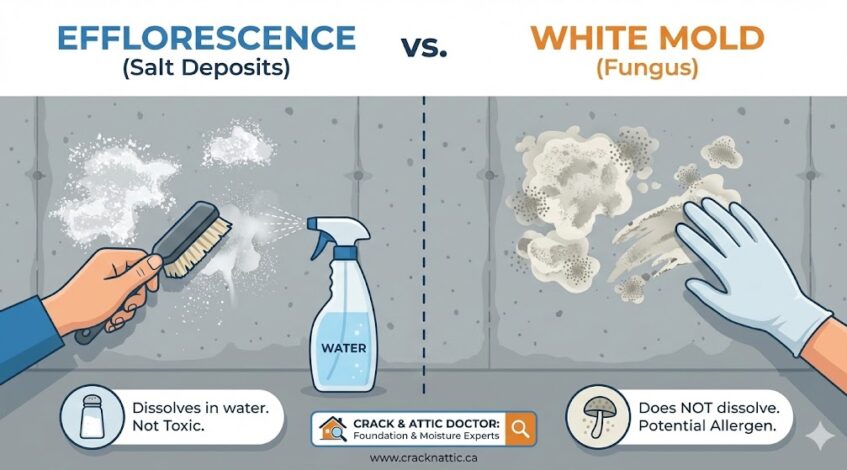
If you’ve noticed a white, fuzzy, or powdery substance creeping across your basement concrete or crawl space walls, your first instinct might be worry. “Is it mold?” In Calgary’s climate—where moisture levels fluctuate rapidly during Chinook thaws and spring rains—these spots are incredibly common.
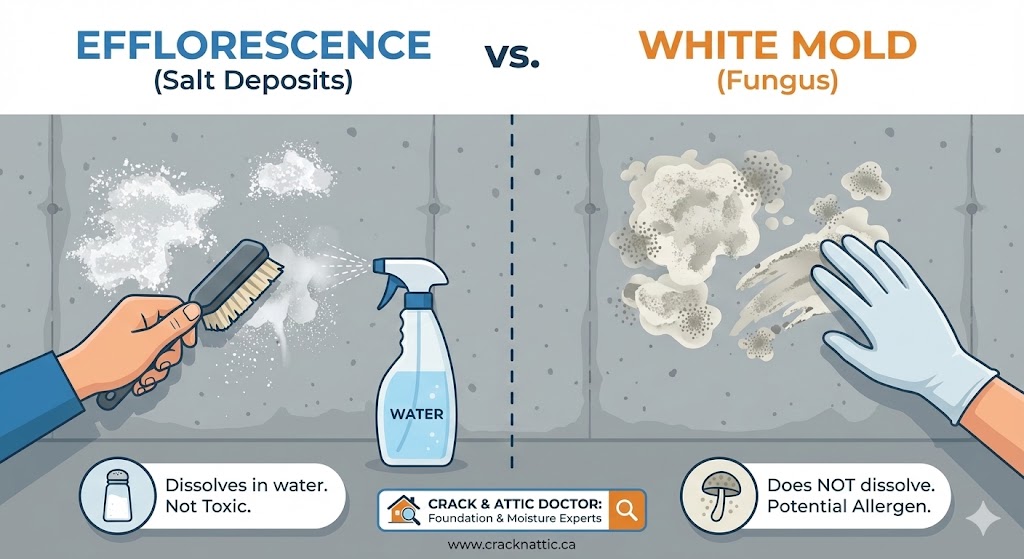
However, they aren’t always what they seem. Usually, you are looking at one of two things: Efflorescence or Mold. Knowing the difference is the key to protecting both your home’s value and your family’s health.
What is Efflorescence?
Efflorescence is actually a collection of salt deposits. Concrete, brick, and mortar contain natural mineral salts. When water seeps through your foundation walls, it dissolves these salts. As the water evaporates on the interior surface, it leaves the salt behind as a white, powdery residue.
-
Is it dangerous? No, it is not toxic.
-
Is it a problem? Yes. While the salt is harmless, it is a “red flag” that indicates water is migrating through your foundation. If left unchecked, this moisture can lead to structural cracks or mold.
What is White Mold?
White mold is a fungus that thrives in damp, dark environments with an organic food source (like wood, drywall paper, or even the dust settled on concrete). Unlike efflorescence, mold is a living organism.
-
Is it dangerous? Yes. It can cause respiratory issues, allergies, and can lead to rot in your home’s framing.
-
Is it a problem? Definitely. It indicates high humidity and poor ventilation.
How to Tell the Difference: The Comparison Table
| Feature | Efflorescence (Salt) | White Mold (Fungus) |
| Texture | Crystalline or powdery; breaks into fine dust. | Fuzzy, slimy, or “thread-like” growth. |
| The Water Test | Dissolves when sprayed with water. | Does NOT dissolve when wet. |
| Smell | Odorless. | Musty, earthy, or “basement” smell. |
| Surface | Only on inorganic surfaces (concrete/brick). | On organic surfaces (drywall, wood, dust). |
| Reaction | Crumbles into sand-like grains when touched. | Smears or stays intact when touched. |
Why This Matters for Calgary Homeowners
In Calgary, Cochrane, and Airdrie, our soil and weather put immense pressure on foundations:
-
Hydrostatic Pressure: During a Chinook, rapid snowmelt saturates the ground, forcing mineral-rich water through microscopic pores in your concrete.
-
Foundation Cracks: As the ground shifts, small cracks can form, allowing water an easy path inside.
If you see white spots, you don’t just have a “spot” problem—you have a moisture management problem.
How Crack & Attic Doctor Protects Your Home
Identifying the white powder is only the first step. At Crack & Attic Doctor, we find the root cause. We specialize in the two most vulnerable parts of your home: the foundation and the attic.
-
Thermal Imaging: We detect cold spots and hidden moisture behind finished basement walls that the naked eye misses.
-
Foundation Audit: We check for structural cracks that may be allowing water entry.
-
Attic Health Check: We ensure your home is breathing correctly to prevent the high humidity that causes mold.
🏠 SPECIALIST HEALTH ASSESSMENT 🏠
Don’t guess when it comes to your home’s foundation or your family’s health.
PROFESSIONAL ATTIC & FOUNDATION AUDIT
Service: Full Moisture Detection & R-Value Check
Booking Code: CNA-WARMTH
Call Today: (403)-321-2623
Website: www.cracknattic.ca
FAQ: Frequently Asked Questions
Q: Can I just scrub efflorescence away?
A: You can clean it with a stiff brush and water, but it will return unless you stop the water from entering the wall from the outside (grading, downspouts, or crack repair).
Q: Does efflorescence cause foundation failure?
A: Not directly, but the salt can build up inside the pores of the concrete (spalling), eventually causing the surface of the concrete to flake or crumble.
Q: Can efflorescence turn into mold?
A: No, salt cannot become a fungus. However, the moisture that causes efflorescence creates the high-humidity environment that mold loves.
Leave a Reply