For decades, foundation repair in Calgary was relatively predictable. You dealt with standard settling or minor shrinkage cracks. But as we move through 2026, homeowners and structural engineers alike are noticing a shift. The culprit? The increasing intensity and frequency of our Chinook cycles.
At Crack & Attic Doctor, we are seeing a “new kind” of foundation damage emerging—one that standard repair methods (like simple patching) fail to address.
The “Thermal Shock” Phenomenon 🌡️💥
Traditional foundation damage is often slow-moving. What we are seeing now is Thermal Shock.
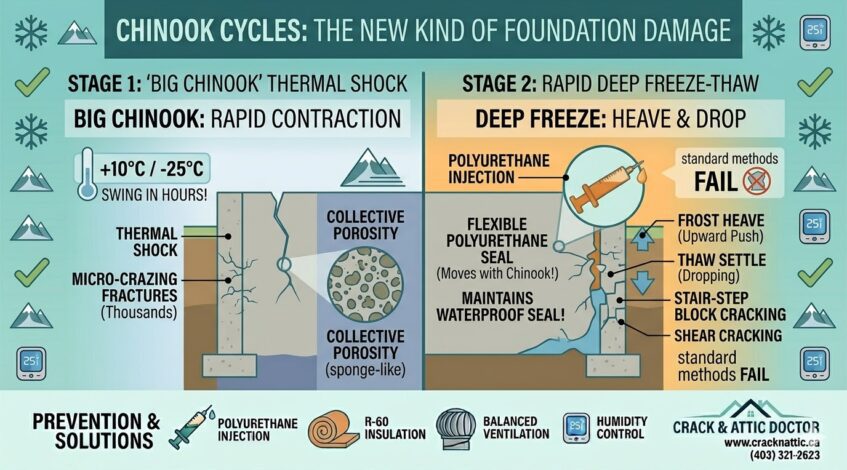
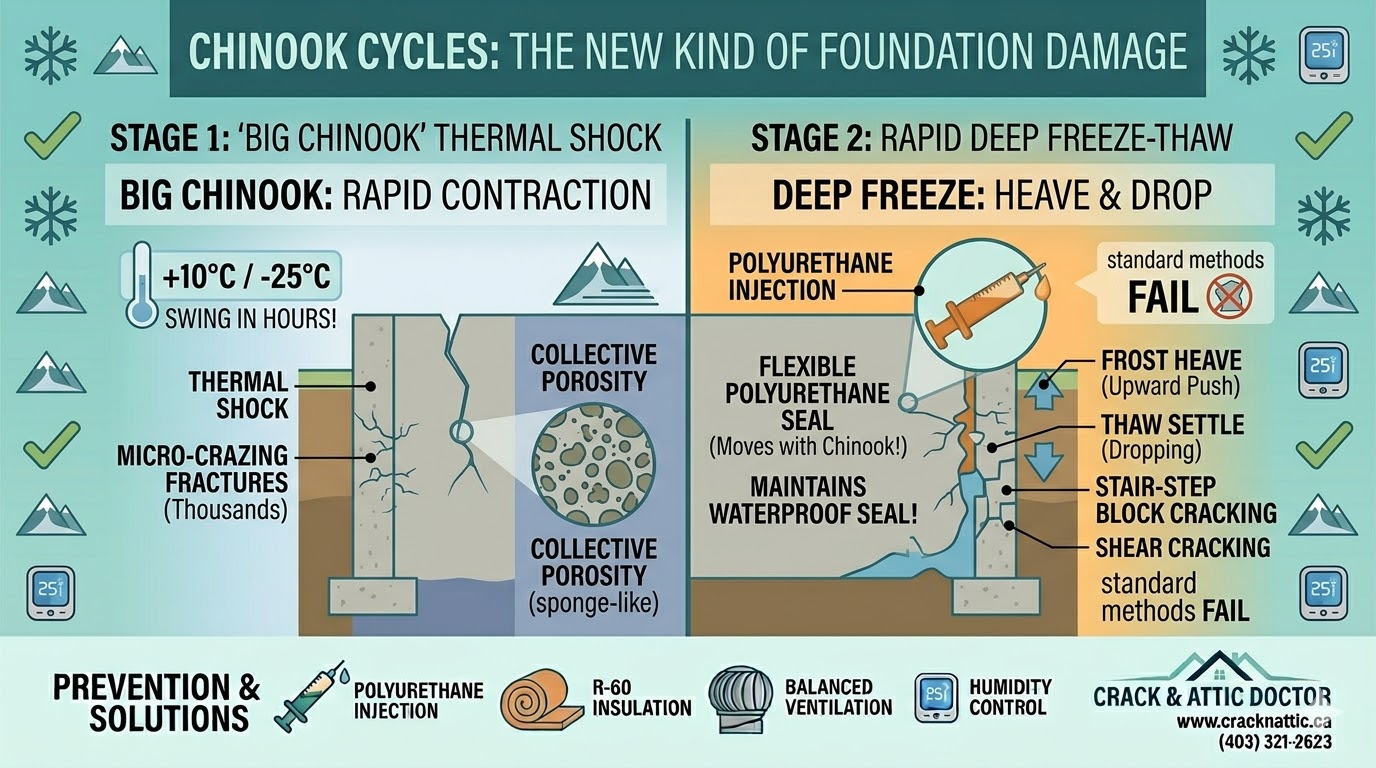
When Calgary experiences a “Big Chinook,” temperatures can swing from -25°C to +10°C in just a few hours. This causes rapid contraction and expansion, not just in the air, but within the concrete itself.
-
The Micro-Fracture Effect: These rapid swings create thousands of microscopic “crazing” cracks. Individually, they aren’t leaks. Collectively, they create a porous concrete surface that acts like a sponge when the snow melts.
-
The Deep Freeze Trap: When the temperature snaps back to -20°C, the moisture inside those new micro-cracks freezes instantly, forcing them to widen into visible, leaking fractures before the next Chinook even arrives.
The “Heave & Settle” Feedback Loop 🔄🧱
Chinooks don’t just affect the air; they affect the ground.
-
The Frost Wedge: During deep freezes, the ground freezes down several feet. The soil expands and exerts massive upward pressure on your footings.
-
The Chinook Thaw: As the surface thaws rapidly, the ground loses its structural support.
-
The Drop: The foundation “drops” back down, often unevenly.
This continuous cycle of being pushed up and dropped down is causing stair-step cracking in block foundations and shear cracking in poured concrete foundations at a rate we haven’t seen in previous decades.
Why Your Home Needs a “2026 Approach” 🛡️💉
Old-school methods are failing because they are too rigid for this new climate reality. You cannot stop a foundation from moving, so you must use materials that move with it.
-
Flexible Polyurethane Injection: Unlike rigid cement, our high-pressure polyurethane remains permanently flexible. It expands and contracts as your foundation reacts to Chinook thermal shock, maintaining a waterproof seal even when the concrete shifts.
-
Perimeter Grading: We are increasingly recommending “Active Drainage Management.” Because our soil moisture levels change so violently, standard weeping tile isn’t always enough—we focus on surface-to-subsurface water redirection.
Is Your Home Suffering from Chinook Damage? 🔍
If you’ve noticed new cracks appearing after a major temperature swing, don’t wait. These aren’t just “settling cracks”—they are the result of an evolving climate.
-
Check for “Telltale” Signs:
-
Fresh, clean cracks in basement walls after a warm spell.
-
Doors that stick only during Chinook events.
-
New damp spots that appear and disappear with the weather.
-
Crack & Attic Doctor is at the forefront of identifying and treating these climate-induced foundation issues. Let’s protect your home from the next big temperature swing.
-
Phone: (403) 321-2623 📱
-
Website: www.cracknattic.ca 🌐
Leave a Reply